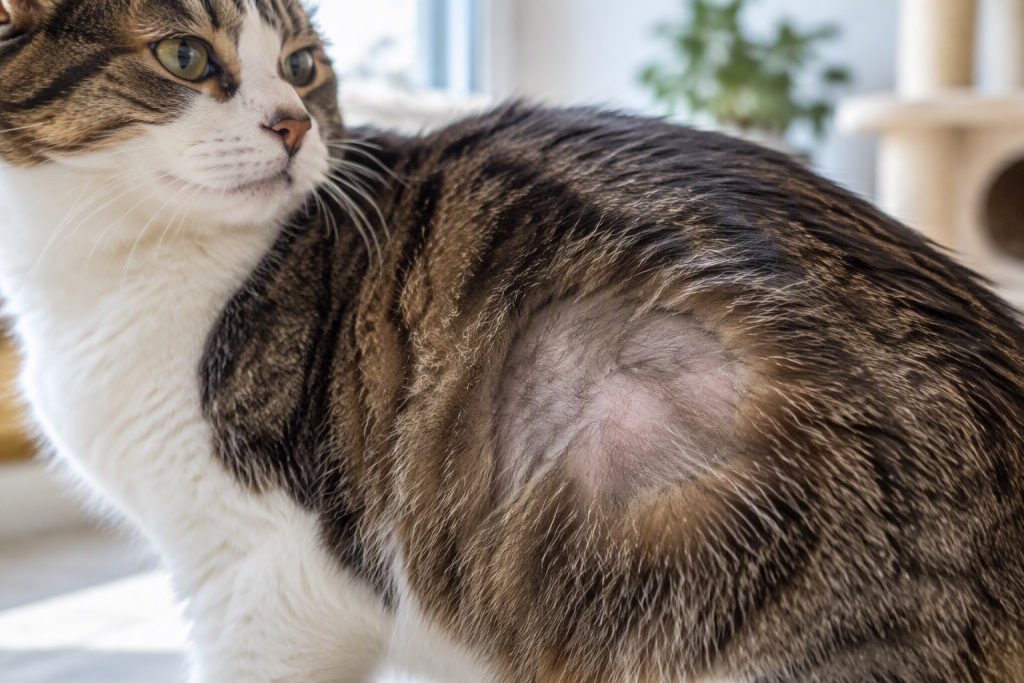
Hair loss in cats usually comes from one of a handful of causes: over-grooming driven by itching or stress, parasites such as fleas and mites, fungal infection, allergies, or an underlying hormonal or skin condition. The pattern matters as much as the loss itself. Symmetrical thinning on the flanks and belly usually points to over-grooming, while patchy, crusty, or scabby areas point more toward parasites, ringworm, or a skin infection. Any hair loss that is spreading, itchy, or accompanied by scabs needs a vet.
- Symmetrical thinning usually means over-grooming.
- Patchy, crusty loss suggests parasites or fungus.
- Fleas are the most common cause of itch-driven loss.
- Spreading or scabby bald patches need a vet.
What is the most common cause of hair loss in cats?
Over-grooming is the single most common cause of symmetrical hair loss in cats, and it is a symptom rather than a diagnosis. A cat who licks, chews, or pulls at her coat for long enough will wear the fur down to a stubble, most often on the belly, the inner thighs, and the flanks. The triggers behind that behaviour are varied: flea allergy, food allergy, environmental allergy, skin infection, pain, or emotional stress from a change in the household. Because the grooming is the visible part, owners often assume it is behavioural, but a large proportion of cases have an underlying physical itch. Our article on cat shedding management explains how to tell normal seasonal coat change from genuine loss, since owners frequently mistake heavy shedding for balding. Start by ruling out fleas with a fine-tooth comb, then look at any recent changes in diet, litter, or routine.
Nail scissors, bath brush, de-shedding glove and a drying towel — the full groom in one box. Cuts…
Which parasites cause hair loss in cats?
Fleas top the list. Even a cat who never goes outside can pick up fleas from a visitor, a dog, or a shared hallway. The itch is often worst at the base of the tail, the lower back, and the neck, and the resulting grooming creates thinning plus small scabs. Some cats are genuinely allergic to flea saliva, so a handful of bites can trigger widespread loss. Mites are the next group: ear mites cause scratching around the head and ears, while walking dandruff and other surface mites cause a scurfy, thinning coat along the back. Ringworm is not a worm at all but a fungal infection, and it produces circular bald patches with a scaly rim, often on the head or forelegs. Ringworm can spread to people, so it is worth confirming rather than guessing. Our guide to cat dandruff treatment covers the flaky, scurfy end of this spectrum.
How do allergies cause a cat to lose fur?
Allergies cause hair loss indirectly. The allergen triggers itching, the cat scratches and over-grooms, and the coat thins. Food allergies in cats often show up as itching around the head, neck, and ears, sometimes with digestive signs as well. Environmental allergies to pollen, dust mites, or mould tend to be seasonal or linked to specific rooms and often affect the face, paws, and belly. Contact allergies from a new litter, a floor cleaner, or a fabric can cause loss on the areas that touch the surface. In all of these cases the skin underneath is often red, warm, or slightly broken, and secondary bacterial or yeast infections are common once the barrier is damaged. Managing an allergy means identifying the trigger, which for food means a proper elimination trial guided by your vet, and for environmental allergens usually means reducing exposure alongside medical treatment.
Can stress make a cat lose hair?
Yes. Stress-related over-grooming is real and common, and it typically produces symmetrical thinning on the belly and inner thighs with no obvious redness or scabs. Cats are sensitive to change, and the usual triggers include a new pet or baby, a move, building work, a change in the owner’s schedule, a new litter or food, or conflict with another cat in the house. Boredom and lack of play can also drive it, especially in indoor cats with no outlet for hunting behaviour. The difficulty is that stress and physical itch look similar, and many cats have both at once. If your vet has ruled out parasites, infection, and allergies, look hard at the environment: litter box numbers and placement, vertical space, hiding spots, and whether your cat has a reliable daily play session. Improving those often reduces the grooming without any medication.

Brush designed to lift loose hair out of a cat's coat — the hair has to go somewhere…
What medical conditions cause feline hair loss?
Several internal conditions show up in the coat. Hyperthyroidism, common in middle-aged and older cats, often produces a poor, greasy, unkempt coat with patchy thinning and sometimes excessive shedding. Kidney disease and other chronic illnesses can lead to a dull coat that thins over time. Diabetes may cause a sparse, dry coat. Skin infections, whether bacterial or fungal, cause localised loss with crusting and sometimes pus. Rarely, an autoimmune condition causes the immune system to attack the hair follicles, producing smooth bald patches. Endocrine and internal causes are usually accompanied by other clues: weight change, appetite change, increased drinking or urination, vomiting, or reduced activity. That is why a vet will often run bloodwork rather than treat the skin alone, and why a bald patch in an older cat deserves more attention than the same patch in a young one.
When should I see a vet about cat hair loss?
See a vet if the loss is spreading, if the skin is red, scabby, crusty, or weeping, if your cat is scratching or biting enough to break the skin, or if you can see bald patches with defined edges. See a vet promptly if there are circular patches with scaly rims, since ringworm can pass to humans, and if there is any hair loss around the head or ears with discharge. Also go if the loss comes with weight change, appetite change, increased thirst, vomiting, or lethargy, because those point to something systemic. Bring a note of when the loss started, which areas are affected, whether it is symmetrical, and anything that changed in the house around that time. Photographs taken weekly are genuinely helpful, because they show the vet the speed of progression. Do not start a medicated shampoo, a supplement, or a diet change before the examination, since these can mask the signs your vet needs to see.
Frequently asked questions
- Is hair loss in cats normal? Heavy shedding is normal. Actual bald patches, thinning, or broken fur are not.
- Can indoor cats get fleas and lose hair? Yes, fleas arrive on clothing, shoes, and other pets, and flea allergy is a common cause.
- Will my cat’s fur grow back? Usually yes once the underlying cause is treated, though it can take several weeks to months.
- Is cat hair loss contagious to other pets? Ringworm and some mites are contagious. Allergies and stress-related grooming are not.
- Can I treat hair loss at home? You can rule out fleas and reduce stress, but spreading or scabby loss needs a vet.