

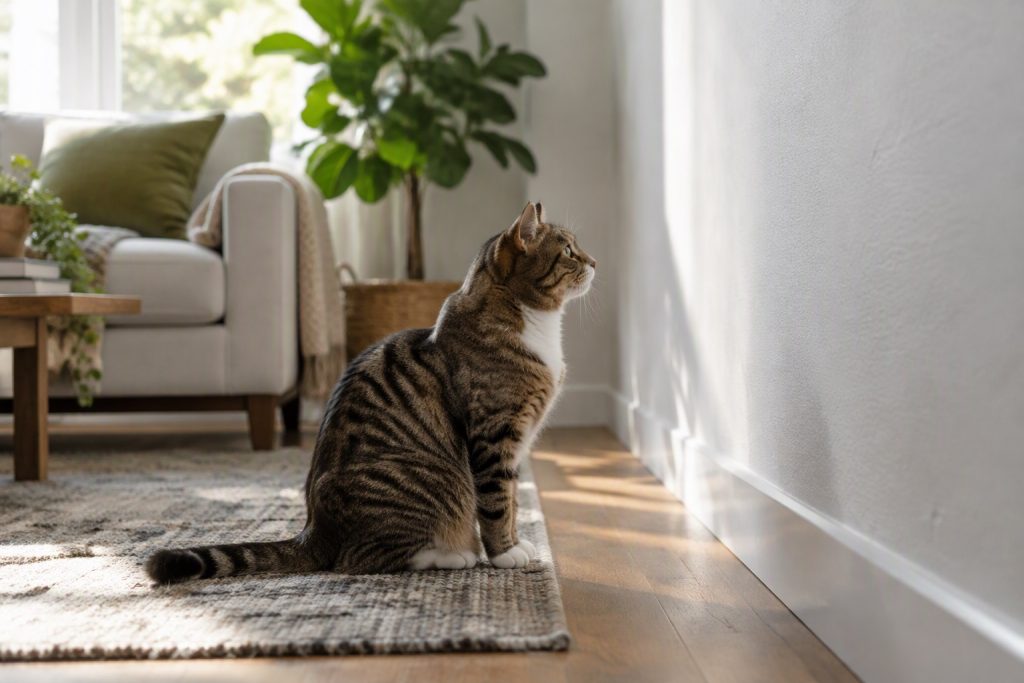
A cat staring at a wall is usually noticing something you cannot perceive: a tiny insect, a shadow, a reflection, a mouse moving inside the cavity, or a sound coming through the wall. Cats also stare at walls when they are concentrating, when they are startled, or when they are in a low-light hunting trance. Occasional wall staring is normal. Staring that is constant, vacant, or accompanied by head pressing or disorientation can indicate a neurological or medical problem and needs a vet.
- Usually she can see or hear something you cannot.
- Insects, shadows, and reflections are common triggers.
- Brief staring is normal hunting focus.
- Vacant staring with head pressing needs a vet.
Why does my cat stare at a blank wall?
The most likely answer is that the wall is not blank to her. Cats detect movement and small detail far better than we do, and they hear a much wider range of frequencies, including sounds from inside walls, behind skirting boards, and outside the building. A spider, a silverfish, a moth, a fly on the ceiling casting a shadow, or a tiny movement in a corner is often invisible to us but obvious to a cat. Rodents moving in a wall cavity produce scratching and rustling that a cat will track with intense focus. Reflections from a phone screen, a watch, or a passing car can also create brief moving lights. Then there is the possibility that the trigger has gone: a cat may continue to watch a spot where something interesting happened earlier. Our article on why cats stare at me covers the related behaviour of staring directly at a person, which has different meanings.
Made from cloth Key features 【Name】 : cat simulation animal sound shell toy[Fill]: No fill, 2 built-in BB…
Is wall staring a sign of a hunting instinct?
Yes, and this is often exactly what it is. A cat’s visual system is tuned to detect motion, and a cat who spots a small moving object enters a state of total concentration that looks like a trance: still body, fixed stare, dilated pupils, and no response to her name. That is the same focus she would use on a mouse. Cats also have a flicker-fusion rate higher than ours, meaning they perceive rapid movement that we see as a blur, so a fast-moving insect that seems to vanish is still visible to her. In low light, cats rely heavily on motion and shape, which is why wall staring is more common at dusk and at night. If you watch closely, you will often see her ears rotate toward a sound or her head follow a tiny movement. That is hunting behaviour, and it is entirely healthy. If the staring comes with chattering, our article on why cats chatter at birds explains that related vocalisation.
Can stress or boredom cause wall staring?
They can. A bored indoor cat who has no outlet for hunting may fixate on small stimuli that a more stimulated cat would ignore, and the staring becomes a way of filling time. Stress can produce a similar effect: a cat who is anxious may freeze and stare as part of a threat assessment, especially if the staring is directed at a corner, a door, or a spot where a frightening event occurred. Some cats develop repetitive staring as a displacement behaviour when their environment is unpredictable or when they are in conflict with another cat in the house. If the staring is happening more than usual, look at her daily routine: how much interactive play she gets, whether she has vertical space and hiding places, whether the litter boxes are adequate, and whether anything in the house has changed. Often, adding a proper evening play session and a food puzzle reduces the behaviour noticeably.
When is wall staring a medical concern?
Take it seriously when the staring looks vacant rather than focused. Warning signs include staring at a wall or into a corner for long periods with no apparent trigger, an unresponsive or glassy expression, and a failure to react to your voice or to food. Head pressing, where a cat pushes her forehead against a wall or furniture, is a specific and important sign that can indicate neurological disease, liver problems, or increased pressure in the brain. Staring accompanied by circling, head tilt, loss of balance, seizures, or a change in behaviour should be assessed urgently. In older cats, cognitive dysfunction can cause staring into space, night-time restlessness, and disorientation. Vision loss is another possibility, since a cat who is going blind may stare at a light source or seem to look at nothing. Any new, persistent, or vacant staring warrants a vet visit, especially in a senior cat.

Rainbow-striped plush cylinder. Keeps a bored indoor cat busy and burns off restless energy. Made from fleece and…
How do I tell normal staring from something wrong?
Watch her body, not just her eyes. Normal hunting focus comes with a tense, alert posture: ears forward or swivelling, pupils dilated, tail low and possibly twitching, body still but ready. She will react if a fly moves or if you make a sudden noise, and she will break off to eat or play. Vacant staring looks different: the posture is often loose or slumped, the ears are neutral, and she does not respond to her name, food, or movement. She may stare at the same spot for many minutes and then appear confused. Head pressing is a separate red flag and should never be dismissed. Another useful test is whether the behaviour is new. A cat who has always watched corners occasionally is normal; a cat who has never done it and suddenly does it for hours is not. Keep a note of when it happens and what precedes it, and take a short video, since that is the single most helpful thing for your vet.
What should I do about wall staring?
If it is brief and clearly focused, do nothing beyond enjoying it, and consider whether there is genuinely something behind the wall, such as a rodent problem, which is worth addressing for its own sake. If it looks like boredom, increase stimulation: two proper wand play sessions a day, a puzzle feeder or treat ball for meals, some vertical space, and a window perch with something to watch. If it looks like anxiety, review the environment for triggers, add hiding places, and keep routines predictable. Never punish the behaviour, and do not try to snap her out of it by shouting, which increases stress. If the staring is persistent, vacant, or comes with any neurological sign such as head pressing, circling, or disorientation, book a vet appointment promptly. For a senior cat, ask specifically about vision, blood pressure, thyroid function, and cognitive dysfunction, since all of these become more common with age.
Frequently asked questions
- Why does my cat stare at the wall at night? Cats see better in low light and are more active then, so small movements and sounds are more noticeable.
- Can my cat see something I cannot? Yes. Cats detect small movements and hear much higher frequencies than humans.
- Is staring at the wall a sign of illness? Brief, focused staring is normal. Vacant, prolonged staring or head pressing needs a vet.
- What is head pressing and why does it matter? It is when a cat pushes her head against a wall or object, and it can indicate neurological or liver disease.
- My older cat has started staring into space. Should I worry? Yes. It can be a sign of cognitive dysfunction, vision loss, or another condition, so have her checked.





