

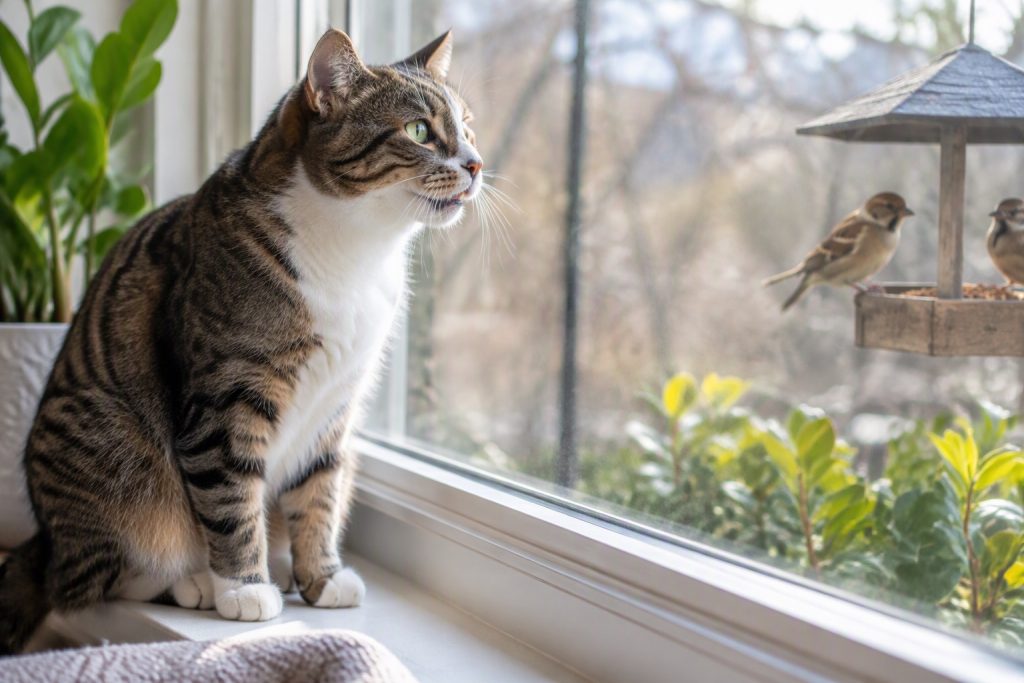
Cats chatter at birds because they are excited by prey they cannot reach, and the rapid jaw movement is thought to be a mix of frustration, anticipation, and a reflex linked to the killing bite. It is a completely normal hunting behaviour, and even well-fed indoor cats do it. Giving her a window perch and some interactive play satisfies the instinct and keeps her entertained without harm to the birds.
- Chattering is excited hunting behaviour.
- It is common in indoor cats watching prey.
- It may link to the killing-bite reflex.
- A window perch and play channel the drive.
Why does my cat chatter at birds?
Chattering is one of the clearest windows into a cat’s hunting instincts. When your cat sees a bird or a squirrel through the window, her brain switches into prey mode, but the glass makes the hunt impossible. The rapid, silent jaw movements, often accompanied by a faint chirping or clicking sound, seem to express the tension between intense excitement and the inability to act. It is a natural response, not a sign of anything wrong, and it appears in cats of all ages and temperaments. Some researchers suggest the movement may imitate a bird’s call, or that it is simply a release of the arousal that builds up when a cat is locked onto prey. Others see it as part of the sequence leading to the killing bite, rehearsed without a target. Whatever the exact mechanism, the behaviour is harmless and fascinating, and it shows that your indoor cat still has the instincts of a hunter. Our article on why cats purr looks at another vocal behaviour with more than one meaning.
Made from cloth Key features 【Name】 : cat simulation animal sound shell toy[Fill]: No fill, 2 built-in BB…
What does the chattering sound mean?
The sound itself is a fast, stuttering series of clicks or chirps made with the mouth slightly open and the jaw quivering. Cats often produce it when they are watching prey they cannot reach, and it can also appear when they are watching a laser pointer or a toy they are about to pounce on. It is different from a meow, a purr, or a hiss, and it seems specific to the hunting context. Owners describe it as sounding frustrated or excited, and those interpretations fit the situation, though we cannot know exactly what a cat feels. What is clear is that chattering accompanies a high state of arousal focused on prey. It is not a sign of pain or illness, and it is not a warning. If your cat chatters while watching a bird, she is simply doing what cats do. You may also see her tail twitch and her body tense, which are other signs of the same hunting excitement. It is harmless and often charming to watch.
Is chattering a sign of frustration?
Frustration is likely part of it. A cat in prey mode wants to stalk, chase, and catch, and a window turns that drive into a dead end. The energy has nowhere to go, and the chattering appears to be a way of discharging some of that arousal. That is why chattering is often most intense when the prey is close but unreachable, and why it can also happen with a toy that keeps escaping. It is not distress in the sense of fear or pain, but it is a kind of excited impatience. The good news is that the behaviour is harmless and does not need to be stopped. What you can do is give the drive a healthy outlet. A window perch lets her watch safely, and a good interactive play session afterwards lets her complete the hunting sequence by stalking, chasing, and catching a toy. That combination satisfies the instinct far better than the window alone, and it often reduces the intensity of the frustrated chatter over time.
Do all cats chatter at birds?
Not all, but many do, and it is common enough to be considered normal cat behaviour. Whether a particular cat chatters seems to depend on temperament, how strong her prey drive is, and how much she has been exposed to birds through windows. A cat with a strong hunting instinct who spends time watching a bird feeder will chatter frequently, while a more placid cat may barely react. Kittens often show the behaviour early, which suggests it is innate rather than learned, though they refine it with experience. Indoor cats chatter more simply because windows are often their only view of prey. Cats who go outdoors may chatter less, because they can actually act on the impulse. Even cats who are well fed and have never hunted chatter, which shows the behaviour is driven by instinct rather than hunger. So if your cat does it, she is in good company, and if she does not, that is normal too.

Rainbow-striped plush cylinder. Keeps a bored indoor cat busy and burns off restless energy. Made from fleece and…
Should I let my cat outside to hunt?
Letting a cat outdoors to hunt carries real risks, both for the cat and for wildlife, and most welfare organisations advise against unsupervised outdoor access. Cats who roam freely face traffic, other animals, disease, and parasites, and they kill large numbers of birds and small mammals. The average lifespan of an outdoor cat is significantly shorter than that of an indoor cat. If your cat is showing a strong hunting drive, you can meet the need safely indoors with interactive play, puzzle feeders, and window perches, which provide the mental stimulation of the hunt without the danger. If you want to give her fresh air, supervised harness walking or a secure outdoor enclosure, sometimes called a catio, is a far safer option. These let her watch, sniff, and explore while staying protected. The chattering is a sign of a healthy instinct, and there is no need to send her outside to satisfy it. Our article on the best window perch for cats shows how to give her a safe front-row seat.
How do I satisfy my cat’s hunting instinct indoors?
Indoor cats need a daily outlet for the hunt, and there is plenty you can do. Interactive wand toys that mimic the movement of birds and mice are the most direct substitute, letting her stalk, chase, and pounce. Move the toy erratically, let her catch it, and finish with a treat or a meal so the sequence feels complete. Puzzle feeders make her work for food, which uses the same problem-solving energy. A window perch or a bird feeder outside the window gives her something to watch, which is stimulating even without a catch. Rotate toys so she does not get bored, and try a few short sessions a day rather than one long one. Some cats also enjoy fetch with a small toy, or chasing a ball. The goal is to give her the full stalk-chase-catch sequence every day, which reduces boredom, frustration, and unwanted behaviour such as night-time activity. A good perch and a good play routine go hand in hand.
Frequently asked questions
- Why does my cat chatter and chirp at birds? It is excited hunting behaviour triggered by prey she cannot reach through the window.
- Is chattering bad for my cat? No. It is normal and harmless, though it reflects unspent hunting energy.
- Does chattering mean my cat is frustrated? Partly. The drive to hunt has nowhere to go, so the arousal is released through the jaw movement.
- Should I stop my cat chattering? There is no need. Give her play and a window perch so the instinct has a healthy outlet.
- Do indoor cats chatter more than outdoor cats? Often yes, because windows are their main view of prey and they cannot act on it.





