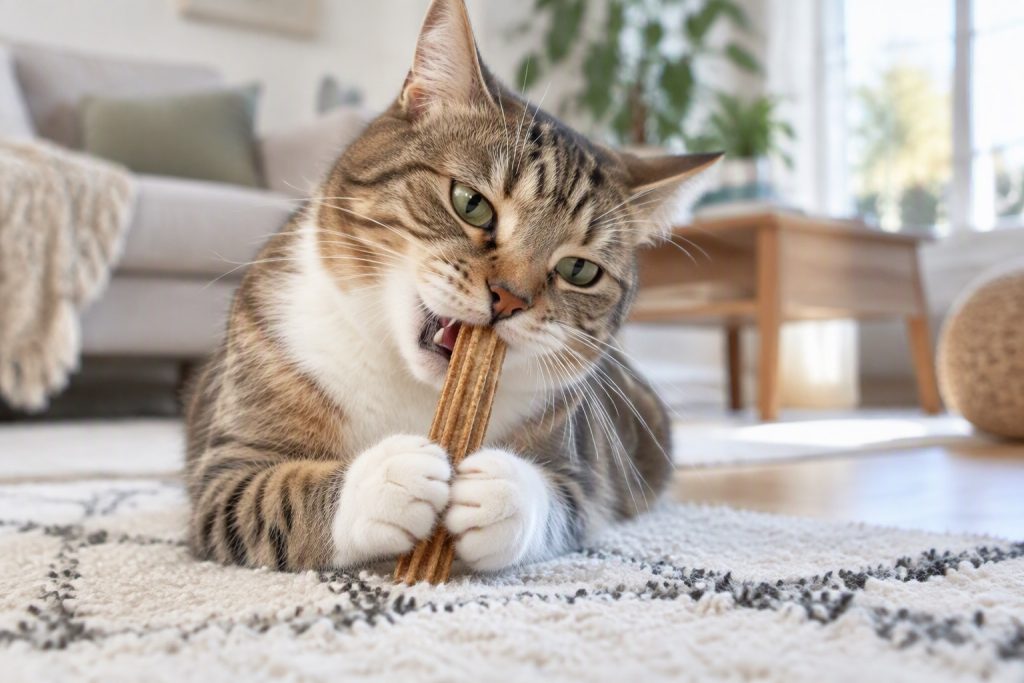
Dental chews can help a cat’s teeth, but they are a supplement to brushing rather than a replacement for it. Chews work mainly by abrasion and by stimulating saliva, which can reduce plaque and tartar on the teeth a cat actually chews with. They do nothing for the gum line where most dental disease starts, and some are too hard or too high in calories to give freely. Used sensibly, they are a useful extra layer.
- Chews reduce plaque but do not replace brushing.
- They mostly clean the chewing teeth, not the gum line.
- Choose a soft, cat-sized, low-calorie option.
- Hard chews can crack teeth, so avoid them.
Do dental chews actually clean a cat’s teeth?
Partly, and the honest answer is that their effect is modest. As a cat chews, the texture of the treat rubs against the tooth surface and helps dislodge soft plaque before it hardens into tartar. Chewing also increases saliva flow, which buffers acids and helps rinse the mouth. The limitation is coverage: a cat chews with her back teeth, so a chew mostly works on the premolars and molars on the sides of the mouth, and does very little for the front teeth or the gum line, which is exactly where gingivitis and periodontal disease begin. Dental chews with a recognised veterinary oral health claim have been tested to a standard, which is worth looking for on the packet. Treat chews as one part of a routine, not the whole of it, and keep your expectations realistic. It also helps to think about where the chew spends its time. A cat works a chew between her back teeth, so the surfaces that get the most friction are the ones she grinds against, and the very front of the mouth and the gum line barely benefit at all.

Clear glass bowl holding dry food. Made from plastic. Made for daily feeding and fresh water. Keeps food…
How do dental chews compare with brushing?
Brushing is still the gold standard, because a brush physically removes plaque from every surface, including right at the gum line, and it can be done daily. No chew can match that coverage. That said, brushing is not always realistic: some cats will not tolerate it, some owners cannot manage it, and life gets busy. In that situation a chew is far better than nothing, and it can slow the accumulation of plaque between brushings. The strongest routine combines both: brush as often as your cat allows, and use chews on the days you cannot. If you have never brushed your cat’s teeth, our guide on how to brush cat teeth shows a gradual, low-stress way to build the habit, starting with a finger and cat toothpaste before introducing a brush. Even two or three sessions a week makes a measurable difference.
What should I look for in a cat dental chew?
Start with size and texture. A chew should be small enough that your cat can work on it without struggling, and soft enough to flex or bend slightly rather than shatter. Look for a product with a veterinary oral health claim, which means it has been tested against a recognised standard, and check the ingredient list for anything your cat reacts to. Calorie content matters, because dental chews are treats: if your cat is prone to weight gain, choose a low-calorie option and reduce her regular food slightly to compensate. Avoid chews that are rock hard, such as antlers, hooves, or very dense bones, because they are a common cause of fractured teeth in cats. Avoid anything small enough to be swallowed whole, and pick a shape that encourages chewing rather than gulping. If your cat has a sensitive stomach, introduce any new chew slowly, and keep an eye on her stools for the first few days, since some chews contain ingredients that do not agree with every cat.
How often should I give dental chews?
Daily use gives the most benefit, because plaque begins to harden within about a day, so a chew every day interrupts that process more effectively than an occasional one. Many cats do well with one chew a day, given at a consistent time, such as after their evening meal, when saliva flow is useful. If your cat is overweight or on a prescription diet, one every other day may be a better balance, and you should account for the calories. Always supervise the first few, and remove any remnant once it becomes small enough to swallow. Introduce chews gradually so they do not upset the stomach, and never use them as a substitute for a meal. If your cat has existing dental disease or missing teeth, ask your vet whether chews are appropriate before you start.
Nail scissors, bath brush, de-shedding glove and a drying towel — the full groom in one box. Cuts…
Are there risks or chews to avoid?
Yes, and they are worth taking seriously. Hard chews can fracture teeth, which is painful and often needs extraction, and cats are more prone to this than many owners expect. Chews that break into small pieces can be a choking hazard, and anything that can be swallowed whole risks an obstruction. Some chews are very high in calories and can quietly contribute to weight gain. Rawhide is not recommended for cats, and any chew that splinters should be avoided entirely. Watch for signs of trouble while your cat chews: dropping the chew, pawing at the mouth, drooling, or refusing to continue can indicate pain. If a chew disappears quickly, it is too small or too soft to do any good. Match the chew to your cat’s size and dental health, and supervise until you know how she handles it. A simple rule is that if you can bend the chew with your fingers, it is probably soft enough, and if you cannot dent it at all, it is too hard for a cat’s teeth. When in doubt, choose the softer option.
When do dental chews not solve the problem?
Chews will not fix established dental disease. If your cat has bad breath that persists, red or bleeding gums, drooling, difficulty eating, pawing at the mouth, or visibly brown tartar, she needs a veterinary dental assessment, not more treats. Gum disease and tooth resorption are common in cats and are painful, and they need professional cleaning or extraction under anaesthesia. Our article on cat bad breath explains when odour signals something more than a minor issue. Chews can help maintain a healthy mouth after a dental clean, and they can slow plaque between brushings, but they cannot remove hardened tartar or treat infection. If your cat shows any of the signs above, book a vet visit. Oral health that persists as a problem is best handled professionally, and early treatment is far kinder than waiting.
Frequently asked questions
- Can dental chews replace brushing? No. They help reduce plaque, but brushing cleans far more thoroughly, especially at the gum line.
- How often should cats get dental chews? Daily gives the most benefit, with calories counted as part of her daily intake.
- Are dental chews safe for kittens? Only if they are labelled for kittens and soft enough; ask your vet if you are unsure.
- Why does my cat’s breath still smell? Persistent bad breath usually means dental disease, which needs a veterinary assessment.
- Are hard chews bad for cats? Yes. Very hard chews can fracture teeth and should be avoided.