

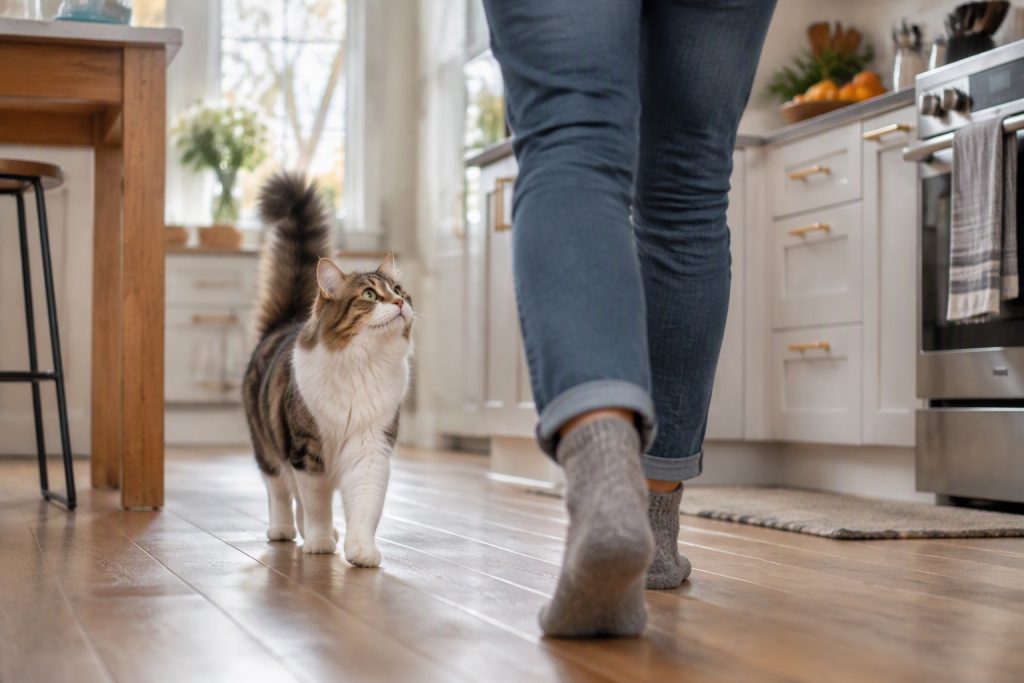
Cats follow their owners to the kitchen because the kitchen is where food comes from, and cats are quick to learn which room predicts a meal or a treat. It is usually a mix of hunger anticipation, routine, and affection. If she is fed on a schedule and still begs, the behaviour is more about habit and attention than genuine hunger.
- The kitchen means food to a cat.
- Following is often routine and habit.
- Do not feed on demand.
- Sudden clinginess can signal a problem.
Why does my cat follow me to the kitchen?
Your cat follows you to the kitchen because she has learned that this room predicts something good. Cats are excellent at forming associations, and if the kitchen is where you prepare her meals, open the fridge, or hand out the occasional treat, she quickly connects the room, the sounds, and your movement with food. The sound of a tin opening or a cupboard door can bring her running from anywhere in the house. Following you is also social: cats who are bonded to their owners often move through the home with them, and the kitchen is simply the destination. Some cats follow because they are genuinely hungry and their meal is due, while others do it out of habit, even when they have just eaten. Attention-seeking plays a part too, since following often gets a reaction, whether that is food, a stroke, or just your voice. Understanding which of these is driving the behaviour helps you respond sensibly. Our article on why a cat follows you covers the wider pattern.

Rainbow-striped plush cylinder. Keeps a bored indoor cat busy and burns off restless energy. Made from fleece and…
Is my cat hungry or just hoping?
It can be hard to tell, because the behaviour looks the same either way. Genuine hunger is more likely if it is close to a mealtime, if she has recently been more active, if her portions have been reduced, or if she is a growing kitten or an older cat with a condition that increases appetite, such as hyperthyroidism or diabetes. Hoping is more likely if she follows you to the kitchen constantly, including right after a full meal, and if she is a healthy weight and otherwise well. A useful check is her body condition and weight trend, since a cat who is genuinely underfed will lose weight, while a cat who is simply opportunistic will not. Look at the timing too: a cat who begs all day, every day, regardless of meals, is usually acting on habit. If you are unsure whether she is getting enough, our article on how much to feed a cat can help you check portions against her needs.
How do I stop my cat begging in the kitchen?
The key is to break the association between the kitchen and free food, and to be consistent. Feed your cat at set times in a fixed spot, ideally not in the kitchen if that is where she begs, and stick to the schedule so she learns when food arrives. Never give in to begging, because even occasional rewards teach her that persistence works, and the behaviour will get stronger. Ignore the begging calmly, without scolding, and avoid giving attention of any kind, including pushing her away, which some cats read as interaction. If she follows you into the kitchen, you can simply walk past without reacting, or close the door while you cook. Use a puzzle feeder or a timed feeder to spread her meals out and reduce the focus on you. Keep treats for training, not for begging. Finally, make sure she is genuinely well fed and not underweight, so you are confident the behaviour is habit rather than hunger. Consistency over a week or two usually reduces it.
Should I feed my cat when she follows me?
Generally, no, unless it is her scheduled mealtime. Feeding a cat when she follows you to the kitchen rewards the following and teaches her that pestering produces food, which makes the behaviour more frequent and more intense. It also risks overfeeding, since owners who give in to begging often lose track of how much their cat is actually eating, and obesity is a serious health problem in cats. If she is genuinely due a meal, feed her at the set time in her usual spot, not as a response to following you. If you want to give her something, use it as part of a structured routine, such as a small portion in a puzzle feeder at a predictable time, rather than as a reward for begging. That way she still gets enrichment without learning to nag. If you are worried she is truly hungry, review her daily portions carefully and adjust the amount rather than the timing.
Made from cloth Key features 【Name】 : cat simulation animal sound shell toy[Fill]: No fill, 2 built-in BB…
Could following me be a sign of something else?
Usually it is benign, but a change in the behaviour can be meaningful. A cat who suddenly becomes much more clingy, following you everywhere and seeming unsettled, may be stressed, bored, or unwell. Cats who are in pain or feeling ill sometimes seek more contact, and increased clinginess alongside appetite changes, hiding, or lethargy is worth a vet visit. A cat who follows you and vocalises constantly, or who seems anxious when you leave the room, may be experiencing separation-related stress, which is more common than people think. Boredom is another possibility, especially in an indoor cat with limited stimulation. If the following is new and intense, review recent changes in the household and consider whether she needs more play, enrichment, and predictable routines. If it comes with any physical signs, see your vet. Health topics that persist are always best discussed with a professional rather than managed indefinitely at home.
When should I worry about a cat following me everywhere?
For most cats, following you is normal and affectionate, and there is nothing to worry about. It becomes worth attention if it is new, if it is accompanied by distress, or if it comes with signs of illness. See your vet if your cat seems anxious, paces, vocalises excessively, or cannot settle when you are apart, especially if she is also eating less or hiding. Seek prompt care if following is joined by vomiting, diarrhoea, weight loss, or lethargy, since these can indicate a medical problem. If the behaviour is driven by boredom, more play and enrichment usually help. If it appears to be separation-related, a behaviourist or your vet can advise. Trust your instincts: a cat who has always shadowed you is simply attached, but a sudden change in a settled cat deserves a closer look. When in doubt, a check-up is a reasonable, low-risk step.
Frequently asked questions
- Why does my cat follow me to the kitchen every time? She has learned that the kitchen predicts food, so it is routine and anticipation.
- Is my cat following me a sign of love? It often reflects a close bond, though it is also driven by routine and food.
- Should I ignore my cat when she begs? Yes, ignore calmly and feed only at set times to avoid rewarding begging.
- Why does my cat follow me even after eating? Habit and attention-seeking, rather than hunger, usually explain this.
- When is following a cat everywhere a concern? When it is sudden, comes with distress, or is joined by signs of illness.





