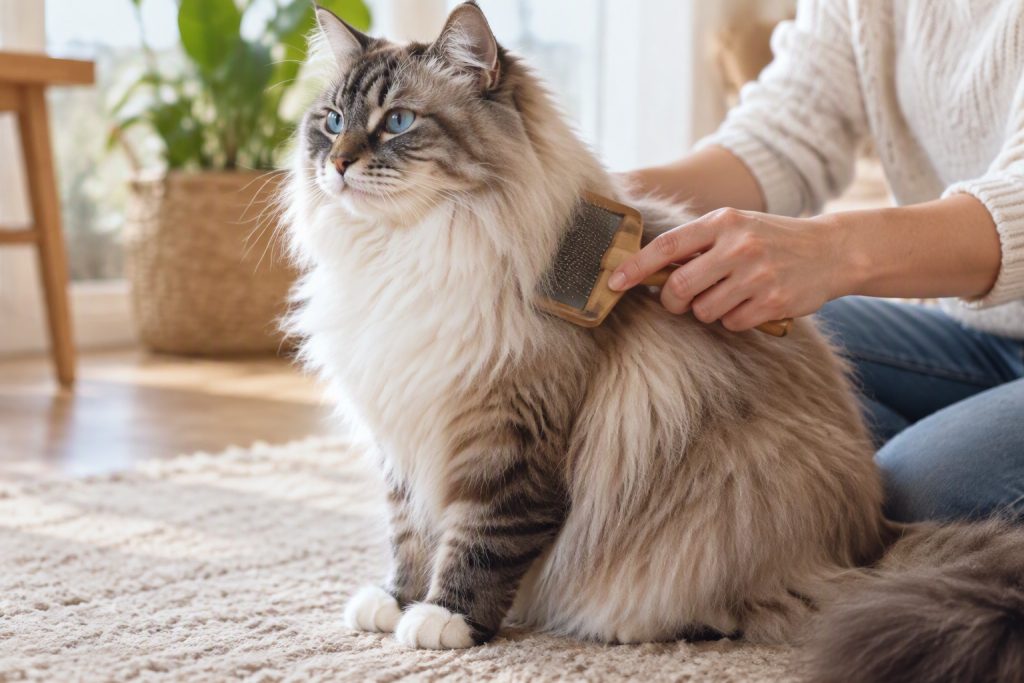
The best brush for a long-haired cat is a wide-toothed stainless-steel comb for the undercoat, paired with a slicker or pin brush for the topcoat. Long-haired cats need grooming every day, or at least every other day, because their coat mats quickly once dead fur is trapped against the skin. The right tools, used gently and consistently, prevent mats far more easily than they remove them, so a few minutes a day saves a great deal of trouble later.
- Use a wide-toothed metal comb for the undercoat.
- Add a slicker brush for the topcoat and loose fur.
- Groom daily, or at least every other day.
- Work in small sections and never yank through mats.
What is the best brush for a long-haired cat?
A long-haired cat needs more than one tool, because a single brush cannot handle both the topcoat and the dense undercoat. A stainless-steel greyhound comb, with one wide-toothed side and one finer side, is the workhorse: the wide teeth detangle, and the fine teeth find small knots before they become mats. A slicker brush, with its fine bent wires, removes loose fur and smooths the topcoat, while a pin brush with rounded tips is gentler for cats with sensitive skin. For very dense coats, a rake or undercoat comb reaches deeper and removes the dead undercoat that causes most matting. Start with the comb, since it tells you where the tangles are, then follow with the slicker. Whatever you choose, the teeth should be smooth and rounded, not sharp, and the handle should feel comfortable in your hand for the few minutes you will use it each day.
Nail scissors, bath brush, de-shedding glove and a drying towel — the full groom in one box. Cuts…
Why does my long-haired cat get mats?
Mats form when dead undercoat fur sheds but does not fall away, instead tangling with the living coat and tightening into a knot. Long-haired cats are especially prone because their fur is fine and dense, so shed hairs catch on each other rather than dropping out. Friction from lying down, collar rub, and the natural movement of the coat all push tangles tighter over time. A mat left alone pulls on the skin, which is painful, and can hide sores, parasites, or skin infections underneath. Several things make matting worse: infrequent grooming, a cat who cannot reach certain areas because of arthritis or weight, dry indoor air, and static. Older cats who groom less are especially vulnerable, as are cats who have stopped grooming because they feel unwell. If your cat suddenly develops mats after years of a tidy coat, that change is worth mentioning to your vet, since reduced grooming is often an early sign of discomfort or illness.
How often should I brush a long-haired cat?
Daily is the gold standard for a long-haired cat, and every other day is the practical minimum. The reason is that mats tighten quickly: a small tangle caught today is a two-minute fix, but the same tangle left for a week becomes a solid knot that may need scissors or a vet. A short daily session of five minutes, done at the same time each day, is far more effective than a long, stressful session once a week. Focus on the areas where mats form first: behind the ears, under the chin, the armpits, the belly, and the base of the tail, as well as the hind legs and the ruff. Work in small sections, combing from the ends of the fur toward the skin rather than pulling from the root. If she will only tolerate a few minutes, do the problem areas first and build up her tolerance gradually. Our guide to how often to brush your cat covers the same routine for all coat types.
Which brush is better, slicker or comb?
They do different jobs, so the honest answer is that you need both. A slicker brush removes loose surface fur and gives the coat a smooth finish, and many cats enjoy the sensation, which makes it a good tool for building trust. But a slicker alone can skim over the topcoat and miss the tangles hiding underneath, which is exactly how mats start. A metal comb reaches the skin, parts the coat, and reveals knots early, so it is the tool that actually prevents mats. The most effective routine is comb first, working through the coat section by section to find and separate tangles, then slicker to lift out the loosened fur and smooth the surface. If you can only keep one tool, choose the comb, because it does the essential work. Add a pin brush if your cat has a sensitive skin, since its rounded tips are gentler than a slicker’s wires.
Brush designed to lift loose hair out of a cat's coat — the hair has to go somewhere…
How do I remove a mat without hurting my cat?
Never pull a mat out with a brush or comb, because that tears the skin and teaches your cat to hate grooming. Instead, work at it slowly. Hold the mat between your fingers near the skin to protect it, then use the wide teeth of a comb or your fingers to tease the outer edges apart, working from the outside in. A little cornflour or a dedicated detangling spray can reduce friction, but avoid anything with strong perfume. Take breaks and reward her, and if she becomes distressed, stop and try again later. If a mat is tight against the skin, do not cut it with scissors, because it is very easy to slice the skin underneath. Use blunt-tipped grooming scissors or a mat splitter with the comb between the blade and the skin, or let a groomer or vet handle it. Our article on stopping matting in long-haired cats has more on prevention.
Do long-haired cats need baths or trims?
Most long-haired cats do not need regular baths, and bathing too often strips the natural oils that keep the coat healthy. A bath is useful when a cat is genuinely dirty, has got into something sticky, or needs a medicated shampoo for a skin condition, and it should be followed by thorough drying, since a damp coat mats even faster. A sanitary trim around the rear is helpful for cats who get stool caught in their fur, and a light trim of the belly and armpits can reduce matting in those hard-to-reach areas. Many owners also have the coat trimmed shorter in summer for comfort, though this changes the look and needs a professional groomer to avoid cutting the skin. Brushing matters far more than bathing or trimming. A daily groom keeps the coat clean, distributes natural oils, and lets you spot lumps, fleas, or sore patches early.
Frequently asked questions
- Can I use a human hairbrush on my cat? It is not ideal. Human brushes miss the undercoat. Use a cat comb and slicker instead.
- How long should grooming take? About five minutes a day is enough for most long-haired cats if you do it consistently.
- My cat hates being brushed. What can I do? Start with short sessions, use a gentle tool, and reward her. Build tolerance slowly over weeks.
- Should I shave my long-haired cat in summer? Only with professional advice. Shaving can affect temperature regulation and sun protection.
- Are mats painful for cats? Yes. A tight mat pulls on the skin and can hide sores, so treat them promptly.