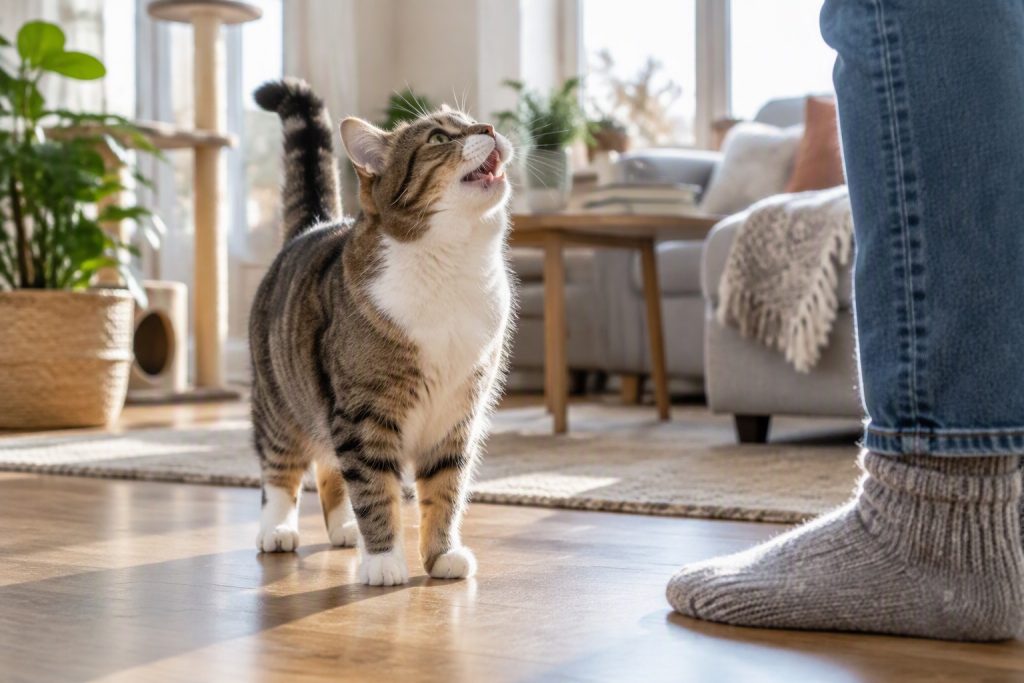
Cats meow mainly to communicate with people, not with each other, so a cat who meows a lot is usually trying to get your attention. Common reasons include hunger, boredom, wanting to go out or come in, pain, stress, and in older cats, confusion or a medical problem such as hyperthyroidism. The meow itself is normal; what matters is whether it has changed and what it is asking for. Once you work out the pattern, most excessive meowing can be reduced without much fuss.
- Meowing is mostly aimed at humans.
- Hunger, boredom, and stress are common causes.
- A sudden change in meowing can mean illness.
- Never ignore a new or distressed meow.
Why does my cat meow so much?
Adult cats rarely meow at each other; the behaviour is largely reserved for communicating with people, which means a chatty cat has learned that meowing gets a response. The most common trigger is hunger, especially if meals are irregular or she has learned that meowing produces treats. Boredom is another big one, particularly in indoor cats who need play and stimulation, and a cat with nothing to do will often follow you around vocalising. She may also meow to be let out, to be let in, to ask for a lap, or simply to announce that she is there. Stress from a change in routine, a new pet, or a move can increase vocalising, as can pain or discomfort. In older cats, increased meowing is often linked to hyperthyroidism, high blood pressure, or cognitive decline, so a sudden change always deserves a vet visit.

Rotating Self-Hi Relieving Stuffy Cat Teaser Feather Pet Toy. Part of the KiKi Meow Cat Toys collection for…
Which meows mean what?
Cats produce a range of sounds, and the context matters as much as the tone. A short, sharp meow is often a greeting or a request, while a long, drawn-out meow tends to mean a demand, such as for food. A low, rumbling meow can signal annoyance or complaint. The chirrup or trill, a friendly rolling sound, is usually a happy greeting, often used when a cat approaches you. A yowl is louder and more insistent, and it can mean distress, pain, or a cat in heat, while a hiss or a growl is a clear warning to back off. Older cats sometimes produce a loud, mournful howl at night, which is worth investigating. Pay attention to the pitch, length, and repetition, and to what happens next, because the pattern tells you far more than the sound alone. You will learn your own cat’s vocabulary over time. Recordings can help too, since a short video of an unusual meow can be useful to show your vet if you are worried about a new sound.
Is excessive meowing a health problem?
Sometimes, yes. A sudden increase in meowing in a cat who was previously quiet can be an early sign of illness. In older cats, the most common culprits are hyperthyroidism, high blood pressure, kidney disease, and cognitive dysfunction, all of which can cause increased vocalising, especially at night. Pain, dental disease, and digestive problems can also make a cat more vocal. If the meowing comes with weight loss, increased appetite or thirst, changes in litter box habits, or reduced grooming, see your vet promptly. Even without those signs, a marked change in behaviour lasting more than a few days warrants a check, because cats hide illness well and vocalising is sometimes the only clue. If your cat has always been talkative and is otherwise well, that is likely just her personality, and no treatment is needed.
Why does my cat meow at night?
Night meowing is common and usually has a clear cause. Cats are naturally crepuscular, most active at dawn and dusk, so a cat with energy to burn may become vocal when you want to sleep. If she has learned that meowing at night brings attention, food, or play, the behaviour is being reinforced every time you respond. Older cats may meow at night because of cognitive decline, poor eyesight, or pain. To reduce it, build an active play session in the evening so she is tired, feed her a meal before bed, and keep the night environment calm and dark. If she meows, avoid feeding or playing, since that rewards the behaviour, and instead check quietly that she is well. Our guide to why cats bite ankles at night covers the related problem of a cat with too much energy after dark.

Pearl Bird Cat Teaser Feather Pet Toy Bell Cat Playing Rod. Part of the KiKi Meow Cat Toys…
Why does my cat meow at me for food?
Food meowing is one of the most common complaints, and it is almost always a learned routine. If your cat has ever been fed shortly after meowing, she has learned that the sound works, and she will repeat it earlier and louder each time. Cats also have a strong internal clock and will start asking well before the usual mealtime. To reduce it, feed at consistent times, ignore the meowing rather than responding to it, and avoid giving treats when she demands them. If she is genuinely hungry, check that her portion is right for her weight and activity, since underfeeding or a poor-quality diet can leave her unsatisfied. Puzzle feeders and slow feeders stretch a meal out and give her something to do, and our guide to how much play an indoor cat needs explains how to keep her mentally satisfied so she is not asking for food out of boredom.
How do I reduce excessive meowing?
Start by ruling out medical causes with your vet, especially if the behaviour is new or your cat is older. Once health is clear, look at the pattern: what happens right before she meows, and what does she get afterwards? If she is bored, add play sessions, puzzle feeders, and a window perch to give her something to watch. If she is lonely, set aside regular one-to-one time. If she is hungry, review her portion and meal schedule. The key is to reward quiet behaviour and avoid rewarding the meowing, which means not answering every demand. That can be hard at first, and the meowing often gets worse before it improves, but consistency pays off. Never punish or shout at her, since that increases stress and can make the vocalising worse. If nothing helps, ask your vet or a behaviourist for guidance. A qualified behaviourist can watch the pattern in your home and spot triggers you may have missed, and the cost is usually far less than months of disturbed sleep.
Frequently asked questions
- Do cats meow at other cats? Rarely. Adult cats mostly meow at people, using other sounds and body language to communicate with each other.
- Why is my older cat meowing more? Increased vocalising in senior cats is often linked to hyperthyroidism, high blood pressure, or cognitive decline. See your vet.
- Should I ignore my cat’s meowing? Ignore demand meowing once you know she is well fed and healthy, but never ignore a new or distressed meow.
- Can meowing mean my cat is in pain? Yes. A cat in pain may vocalise more, especially when moving or being touched. If you suspect pain, see your vet.
- Is a talkative cat normal? Some breeds and individual cats are naturally vocal. If she has always been chatty and is otherwise well, it is just her personality.