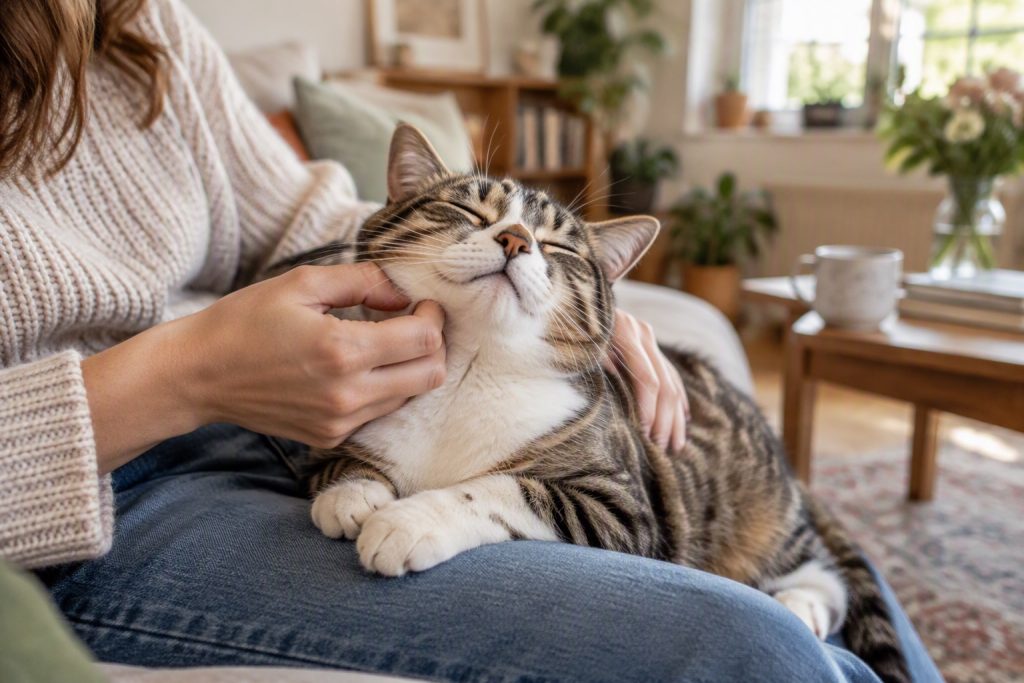
Cats purr by vibrating their laryngeal muscles at a fast, steady rate, and they do it for far more than happiness. Purring usually signals contentment, but cats also purr when they are anxious, injured, or in pain, because the vibration appears to be self-soothing. So a purring cat is not automatically a comfortable cat — you have to read the rest of her body language to know which it is. Learning that difference helps you respond to what she actually needs.
- Purring is made by vibrating laryngeal muscles.
- It usually means contentment, but not always.
- Cats also purr when stressed, hurt, or unwell.
- Read her posture to judge which it is.
Why do cats purr?
Purring appears to serve several purposes at once. In kittens, it begins within days of birth and helps the mother and litter locate one another, so it is a communication tool from the very start. In adult cats, purring most often signals a relaxed, safe state, which is why cats purr when they are being stroked, settling down to sleep, or greeting a trusted person. But cats also purr when they are frightened, at the vet, or recovering from an injury, which suggests the behaviour doubles as self-comfort. The low-frequency vibration may also have a soothing physical effect on the cat producing it. In short, purring is a flexible signal, not a single emotion. That is why the same sound can mean a cat is blissfully happy or quietly miserable, and why context and body language matter so much. Two cats can purr in the same tone while feeling completely different things.

Rainbow Long Plush Cat Pillow Pet Toy. Part of the KiKi Meow Cat Toys collection for cats.
Do cats purr only when they are happy?
No, and this is the most common misunderstanding about purring. A cat in pain, a cat in labour, a cat at the vet, and a cat who is frightened may all purr. Some cats purr almost continuously when they are unwell, which can mislead owners into thinking everything is fine. The reason seems to be that the rhythmic vibration is calming, so a distressed cat uses it the way a person might hum to steady themselves. To tell the difference, look at the whole cat: a content purr comes with soft, forward ears, relaxed whiskers, half-closed eyes, and a loose body. A stressed purr tends to come with flattened ears, tense muscles, a tucked tail, wide pupils, and a cat who is hiding or trying to leave. When the body says one thing and the purr says another, trust the body.
How do cats actually produce the purring sound?
Purring is produced by the rapid opening and closing of the vocal folds, driven by muscles in the larynx, combined with a steady airflow from the lungs. The rate is remarkably consistent, generally between about 25 and 150 vibrations per second, and it happens on both the inhale and the exhale, which is why purring sounds continuous rather than broken. Cats can purr with their mouths closed, so you often feel the vibration through your hand before you hear it. Unlike meowing, which is mostly directed at humans, purring is a more fundamental behaviour shared with kittens and even some big cats. The mechanics are automatic enough that a cat can purr while eating, nursing, or drifting off to sleep, and the vibration you feel is the same one a kitten uses to tell her mother she is nearby and well. It is one of the few behaviours that stays with a cat from birth to old age almost unchanged.
Why does my cat purr and then bite or scratch?
A cat who purrs and then nips is usually overstimulated, not being spiteful. Petting feels good at first, but many cats reach a threshold where the same touch becomes irritating, and the purr continues out of habit while the body tenses. Watch for the warning signs: a twitching tail, flattened ears, dilated pupils, skin rippling along the back, or a sudden freeze. When you see those, stop stroking and let her settle. If this happens at night or during play, she may simply have energy that needs an outlet, and our guide to why cats bite ankles at night explains how to redirect that drive. A short, active play session before bed helps, and our piece on how much play an indoor cat needs shows how to build a routine that leaves her satisfied rather than wired.
Pet Supplies Plush Molar Toy. Part of the KiKi Meow Cat Toys collection for cats.
Can purring heal or calm a cat?
There is a popular idea that a cat’s purr promotes healing, and while the vibration does occur at frequencies that have been studied for bone and tissue effects in other contexts, it is important not to overstate this. What is well supported is that purring seems to soothe the cat doing it. It can lower signs of stress and help a cat settle in an unfamiliar or frightening situation. For owners, the sound is calming too, which is part of why cats are such good company. The honest takeaway is that purring is a comforting behaviour with a likely calming function, not a treatment for illness. If your cat is purring but also hiding, not eating, or moving stiffly, do not let the purr reassure you — those other signs are the ones that need a vet.
When should purring worry me?
Worry when purring comes with signs of illness or distress rather than relaxation. Call your vet if she purrs while hiding, refuses food, breathes rapidly, sits hunched, or cries when touched. A cat who purrs through obvious pain, such as after a fall or during labour, needs urgent attention, and so does one who suddenly purrs nonstop without any of the usual relaxed body language. In older cats, a change in purring habits alongside weight loss or reduced grooming is worth a check. The key is to judge the whole picture, not the sound alone. If she seems unwell in any other way, the purr should never be the reason you wait. Trust your instinct, and when in doubt, a vet visit is always the safer choice. You know your cat’s normal better than anyone, so if the purring feels wrong to you, it is worth having her checked.
Frequently asked questions
- Do all cats purr? Most domestic cats purr, but some do it rarely or quietly, and a few almost never purr at all. That is normal variation.
- Why does my cat purr when she is at the vet? Cats often purr when frightened or stressed as a way to self-soothe, so a purr at the clinic does not mean she is relaxed.
- Is purring always a good sign? No. It usually is, but cats also purr when anxious, in pain, or unwell. Read her body language to be sure.
- Can I tell if my cat is in pain by her purr? Not reliably. Look for hiding, appetite loss, stiff movement, or flinching instead, and see your vet if you are unsure.
- Why does my cat stop purring when I stop petting? She is likely purring in response to the contact. Once it stops, so does the trigger, and she may simply settle or ask for more.