

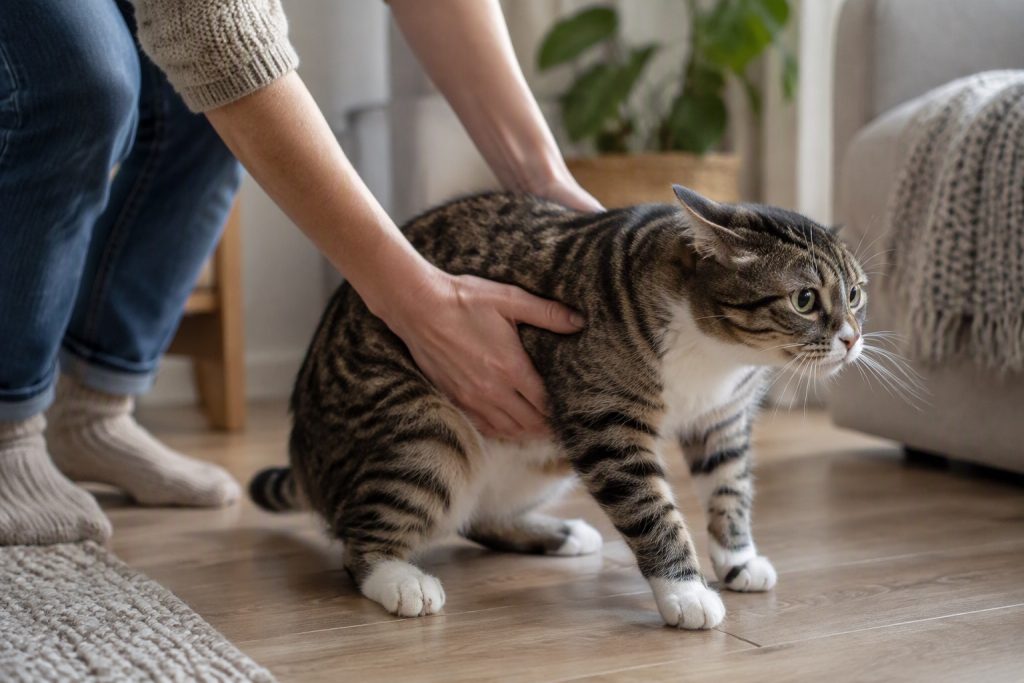
Most cats dislike being picked up, and the reason is usually straightforward: it removes control. A cat lifted off the ground has no say in where it goes, how long it stays or when it is put down, and for an animal whose survival strategy depends on being able to leave a situation, that is genuinely unpleasant. Some cats learn to tolerate it, a few seem to enjoy it, and many will accept being held by one person and not another. Understanding why it happens makes it far easier to work with, and much easier to stop taking personally.
- Most cats dislike being picked up because it removes their ability to leave.
- Many cats accept being held by one person and not another, based on past experience.
- Support the hindquarters, keep it brief, and put the cat down the moment it signals discomfort.
- A cat that suddenly hates being handled may be in pain, so ask a vet.
Why does my cat struggle when I pick it up?
Because being lifted is a loss of control, and cats are built to keep their options open. On the ground, a cat can walk away, jump, hide or freeze, which are all useful responses to something it does not like. In your arms, none of those are available, and the cat is dependent on you to put it down. That is uncomfortable even for a confident cat. There is also a physical element: many people lift a cat with one hand under the chest and no support behind, which leaves the hindquarters dangling and puts strain on the spine and hips. A cat held that way is not being dramatic when it scrambles; it is uncomfortable and unsupported. Small things, such as the smell of a cat that dislikes being held, are also learned rather than innate.

Teaser wand designed to turn a few minutes into a full hunt — a cat needs to finish…
Can I teach a cat to accept being held?
Often, yes, if you go slowly and keep it short. Start with what the cat already accepts: stroking, then a hand on the chest, then a slight lift, then feet just off the floor for a second. Reward with a treat after each step, and stop while the cat is still comfortable rather than pushing until it struggles. Build up the duration in seconds, not minutes. The goal is not a cat that will be carried around, but a cat that does not panic when it needs to be lifted for a vet visit or a nail trim. Some cats never enjoy it, and that is fine. Forcing the issue usually sets the work back. A wand toy can help build positive associations around handling sessions. The same patience pays off for carrier training.
How should I pick a cat up properly?
Use both hands and support the whole body. Place one hand under the chest, just behind the front legs, and the other under the hindquarters so the back legs are supported and not left hanging. Bring the cat close to your body rather than holding it away at arm’s length, because being pressed gently against you feels more secure than being suspended. Keep the hold brief, and lower the cat to a surface rather than releasing it into the air. If the cat tenses, flattens its ears or starts to push away, put it down calmly and immediately, because that teaches the cat that you respect the signal. Never lift a cat by the scruff as a way to carry it, and never pick up a cat that is eating, sleeping or clearly settling somewhere it has chosen.
Why does my cat let one person hold it and not another?
Because the cat has learned what each person does. If one person picks the cat up briefly, supports it properly and puts it down when it asks, the cat learns that being held is safe and predictable. If another person carries the cat around or ignores the signs that it wants down, the cat learns to avoid that person’s hands. Height and voice matter too, and children often move quickly and squeeze, which cats find alarming. It is a history difference rather than a preference for a person, and it can change. The person the cat avoids needs to start with short, well-supported holds and let the cat choose when to leave, and the pattern usually improves within weeks.

Plush toy designed to give a cat something to grab, kick and bite — a cat kills the…
Is it bad to pick a cat up at all?
No, as long as the cat is comfortable and you are respectful. Cats used to gentle, brief handling from a young age are easier to examine, easier to medicate and less stressed at the vet, which is a real welfare benefit. The problem is not the lifting itself but the pattern of lifting a cat that does not want it, holding it too long, or ignoring the signals that it wants down. Those habits teach a cat to avoid hands, which makes necessary handling harder later. If your cat tolerates a few seconds of a supported hold and then asks to get down, that is a good outcome and worth maintaining. The aim is a cat that trusts you, not a cat that has been trained to submit. Necessary handling such as bathing a cat also improves with practice.
When is dislike of handling a health sign?
When it is new. A cat that has always accepted being picked up and suddenly objects is telling you something, and the most common explanation is pain. Dental disease, arthritis, an abscess, a sore back or an abdominal problem can all make a cat flinch when handled, and cats are skilled at hiding it until a specific movement or touch provokes a reaction. Watch for a cat that resists being touched in one particular place, cries out when lifted, or becomes reluctant to jump up as well as reluctant to be held. That combination deserves a vet appointment rather than a training plan. Do not assume a cat has simply become difficult with age, and never give any pain medication without veterinary advice, because several common human painkillers are toxic to cats.
Frequently asked questions
- Do any cats genuinely enjoy being held? Some do, especially cats handled gently from kittenhood. Even those cats usually prefer a short hold with an easy way out.
- Should I scruff my cat to pick it up? No. Scruffing an adult cat is uncomfortable and can cause distress or injury. Support the chest and hindquarters instead.
- My kitten was fine with handling and now is not. Why? Kittens often go through a more cautious phase. Keep sessions short and positive, and check for pain if the change is sudden.
- How do I get a cat that hates being held to the vet? Use a carrier rather than carrying the cat in your arms, and train the carrier at home in advance so the trip is less stressful.
- Is it cruel to never pick my cat up? No. If the cat dislikes it, respecting that is kinder than forcing it. Handling can still be built gradually for practical needs.


