

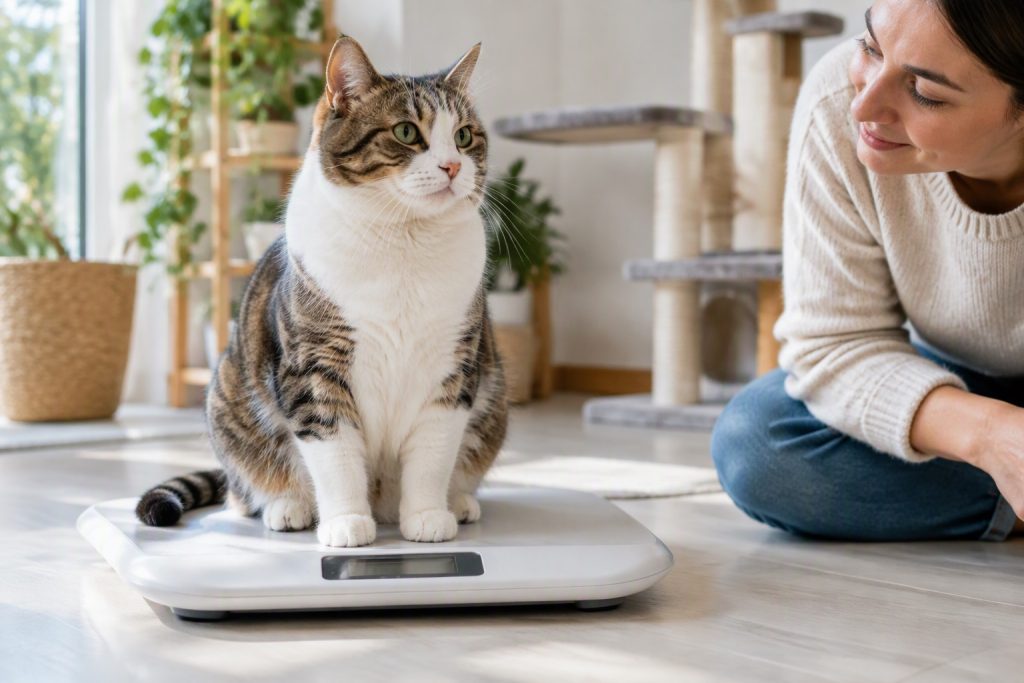
You can weigh your cat at home with an ordinary digital scale by weighing yourself while holding her and subtracting your own weight, or by weighing her inside a carrier and subtracting the carrier. Weigh her monthly, at the same time of day, and keep a record. A steady change in weight without any change in feeding is one of the earliest signs of a health problem, which is why the trend matters far more than how she looks on any single day.
- Weigh yourself holding her, then subtract your weight.
- Or weigh her in a carrier and subtract the carrier.
- Weigh monthly, at the same time of day.
- Log the trend; one reading means little on its own.
How do I weigh my cat at home?
The simplest method uses a digital bathroom scale and a little patience. First weigh yourself alone and note the number. Then pick up your cat and step on the scale again while holding her still, and subtract your own weight from the total. The difference is her weight. For a more accurate reading, use a baby scale or a kitchen scale if she is small, or weigh her inside her carrier: weigh the empty carrier first, then the carrier with her inside, and subtract. A carrier works well for cats who will not sit still in your arms. Weigh her at the same time each month, ideally before a meal and after the litter box, so the numbers are comparable. If she wriggles, weigh her a couple of times and average the results. The exact figure matters less than the pattern over time.

Round bowl with a removable flower insert. Made from PP. Made for daily feeding and fresh water. Keeps…
What is a healthy weight for a cat?
There is no single ideal number, because healthy weight depends on breed, frame, and body type. A typical domestic shorthair sits somewhere between about 3.5 and 5.5 kilograms, but a large Maine Coon can weigh considerably more, and a petite cat can be perfectly healthy at the lower end. This is why vets rely on body condition rather than the scale alone. The number on the scale is most useful as a personal baseline: what matters is whether your cat is stable, slowly rising, or slowly falling over weeks and months. Your vet can tell you a target range for your individual cat at a routine visit, and that target is what you should track against. If you have never been given a target, ask at the next check-up and write it down so future weigh-ins have something to compare to.
How do I check body condition without a scale?
Body condition scoring is a hands-on check you can do at home, and it often tells you more than the scale. Run your hands along your cat’s sides: you should be able to feel the ribs easily under a thin layer of fat, without them sticking out sharply or being buried. Stand behind her and look at the waist; there should be a gentle tuck when viewed from above, not a straight line or a bulge. Feel along the spine and the hip bones, which should be covered but not prominent. A cat who is at a healthy weight has a slight belly, not a sagging pouch that swings, and no visible fat pad over the ribs. If you can feel every bone sharply, she may be too thin; if you cannot feel the ribs at all, she may be overweight. Doing this monthly alongside the scale gives you a fuller picture.
How often should I weigh my cat?
Monthly is a sensible routine for a healthy adult cat, and it is quick once you have a method. For kittens, who grow fast, weekly weigh-ins are more useful, and for senior cats or any cat with a known condition such as kidney disease, thyroid problems, or diabetes, your vet may ask you to weigh her every two to four weeks. The point of regular weighing is to catch change early, when it is easiest to act on. Cats are good at hiding illness, and weight loss or gain often shows up on the scale before it shows in behaviour. Keep a simple log, whether on paper or in a note on your phone, with the date and the number. If you notice a change of more than about five per cent of her body weight without a change in food, that is a reason to call the vet. Our guide to how much to feed a cat helps you set portions that keep her stable.

Gravity-fed dispenser with a rolling ball at the top. Made from plastic. Made for climbing and perching. Gives…
What does it mean if my cat is losing weight?
Weight loss in a cat who is eating normally is a red flag, because it usually means the body is not absorbing or using food properly. Common causes include hyperthyroidism, kidney disease, diabetes, dental pain that makes eating uncomfortable, intestinal problems, and cancer. Sometimes the cause is simpler, such as a recent food change, a new medication, or competition from another cat, but you cannot tell the difference at home. If your cat has lost weight steadily over a few weeks, or has lost a noticeable amount quickly, book a vet visit rather than waiting to see if she improves. Take your weight log with you, since a clear record helps the vet decide how urgent the situation is. Early diagnosis makes a real difference to how well many of these conditions can be managed, so the scale is genuinely one of the most useful tools you have.
What if my cat is gaining weight?
Gradual weight gain is common in indoor cats, especially after neutering, and it carries real risks. Overweight cats are more likely to develop diabetes, arthritis, and skin problems, and they are at higher risk under anaesthesia. If the scale is creeping up, start by measuring her food rather than free-feeding, and reduce treats, which are often the hidden source of extra calories. Encourage activity with short play sessions and puzzle feeders that make her work for her food. A slow, steady loss of about one to two per cent of body weight per week is a safe target, and sudden crash diets are dangerous for cats, because losing weight too fast can cause serious liver problems. If she needs to lose a significant amount, ask your vet to set a target weight and a plan. Older cats who gain weight can also be showing fluid retention, so a sudden change deserves a check-up, as our senior cat care guide explains.
Frequently asked questions
- Can I weigh my cat on a kitchen scale? Yes, if she fits and stays still. Otherwise use a bathroom scale and the hold-and-subtract method.
- How much weight loss is worrying in a cat? Losing more than about five per cent of body weight without a diet change is worth a vet visit.
- Is a saggy belly normal in cats? A small pouch is normal, but a large swinging pad can suggest excess weight. Check her ribs.
- Why does my cat’s weight change between visits? Small differences are normal from time of day, food, and litter box use. Look at the trend.
- How often should I weigh a senior cat? Every two to four weeks is wise, since older cats lose weight easily and hide illness well.





