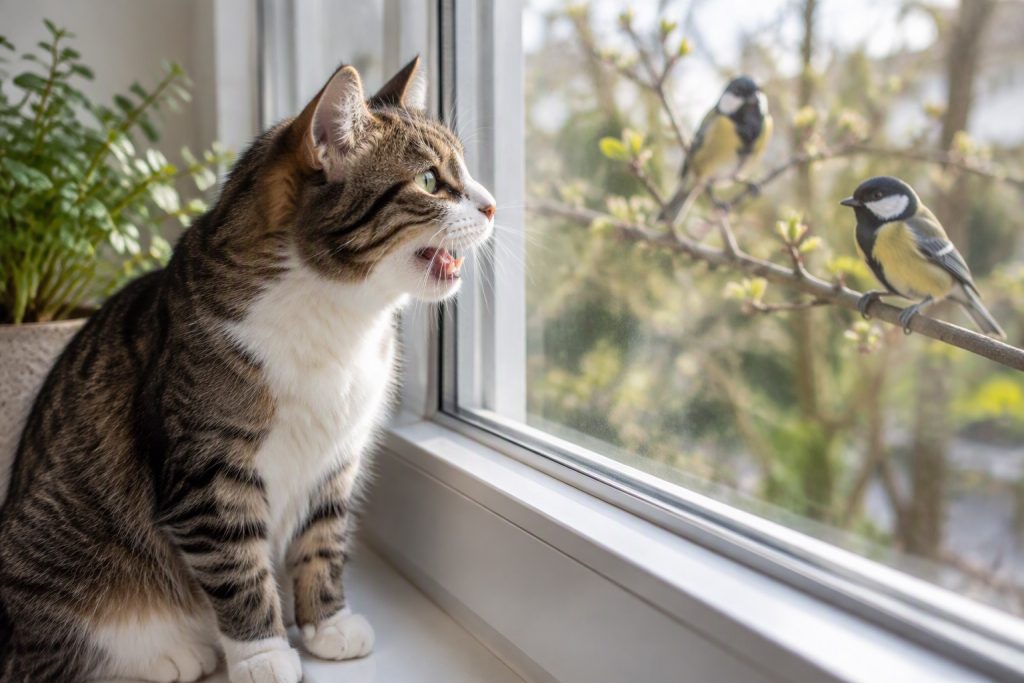
Cats meow at birds because they are locked onto prey they cannot reach, and the sound is part frustration and part excitement. The behaviour often comes with chattering, a rapid jaw movement that appears to mimic a killing bite. It is completely normal hunting behaviour, not aggression toward you, and it is usually harmless as long as your cat cannot actually reach the birds.
- Meowing at birds is frustrated hunting excitement.
- Chattering is a normal part of the sequence.
- It is not aggression toward you.
- Keep windows closed and screens secure.
Why does my cat meow at birds?
When your cat sees a bird through a window, her hunting sequence switches on: she fixes her gaze, crouches, twitches her tail, and often vocalises. The meowing happens because the sequence has no outlet. She cannot stalk, pounce, or catch, so the energy has nowhere to go, and the sound is a release of that arousal. Some cats meow softly and continuously, while others give short, sharp calls. The pitch is often higher than their usual voice, which supports the idea that it is excitement rather than a normal request. Cats who are highly motivated hunters, or who are bored and under-stimulated, tend to do it most. It is worth noting that this is the same drive that makes wand toys so effective: a toy that moves like prey taps directly into the sequence your cat is already trying to run. Our article on why cats chatter at birds looks at the accompanying sound.

Rainbow-striped plush cylinder. Keeps a bored indoor cat busy and burns off restless energy. Made from fleece and…
Is the chattering sound aggression or excitement?
Chattering is widely understood as excitement and frustration rather than aggression. The rapid jaw movement, sometimes with a faint clicking or chirping, looks a little like the biting motion a cat uses to deliver a killing bite to the neck. One common theory is that it is a rehearsed version of that bite, triggered by high arousal. Another is that the jaw movement is an involuntary response to the tension of wanting to pounce but being unable to. Whatever the precise mechanism, it is not directed at you, and it is not a sign your cat is dangerous. Cats chatter at birds, squirrels, insects, and even at toys or laser dots. Some cats chatter silently, with the jaw moving but no sound, and some make a soft, rolling chirp. All of these are normal expressions of a hunting drive that has nowhere to go.
Why does my cat meow but not catch anything?
Because the window is in the way, and because the drive is about the sequence rather than the result. A house cat who has never needed to hunt still carries the full behavioural program, and it fires automatically when prey-like movement appears. She is not failing; she is doing exactly what she is built to do, with the final step blocked. This is why indoor cats who watch a lot of birds can seem restless or fixated, and why the behaviour often intensifies in spring and summer when birds are active. It also explains why a laser pointer can leave some cats frustrated, since the sequence ends without a catch. The fix, if you want one, is to let her complete the sequence safely with a wand toy, and to finish with a treat or a meal so the hunt has a real conclusion. That satisfies the drive without harming wildlife.
Can my cat reach the birds?
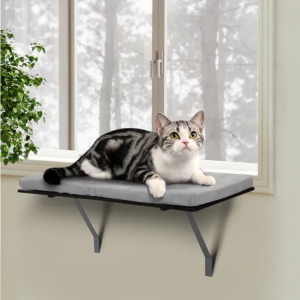
Usually not through a closed window, but it is worth checking the obvious risks. Open windows without screens are the main danger: a cat focused on a bird can lunge and fall, and falls from height can be serious. Window screens should be securely fitted and in good repair, and any balcony should be properly enclosed before you let your cat out on it. If your cat has outdoor access, the risk shifts to wildlife: cats are effective predators, and bird populations suffer where cats roam freely. A bell on the collar has limited effect, and a brightly coloured collar cover can help slightly, but the most reliable protection for birds is keeping your cat indoors or using a secure enclosure. Bird feeders placed close to a window also increase window-strike risk for birds, so position them carefully, ideally within a metre or well beyond three metres. Our guide on the best cat window perch lets her watch safely from inside.
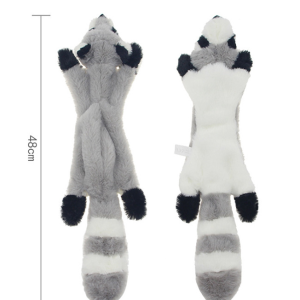
Made from cloth Key features 【Name】 : cat simulation animal sound shell toy[Fill]: No fill, 2 built-in BB…
Should I let my cat watch birds?
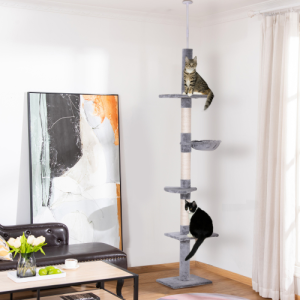
Yes, watching birds is good enrichment for an indoor cat. It provides mental stimulation, taps into natural behaviour, and can keep a cat happily occupied for long stretches, which is valuable for cats left alone during the day. A safe viewing spot, such as a window perch or a cat tree by the glass, gives her a front-row seat without any risk to her or to the birds. The one caveat is frustration. If your cat becomes obsessive, meows constantly, or seems agitated rather than settled, pair the viewing with real play so the hunting sequence gets completed. Some cats also benefit from a screen or a slightly obscured view that reduces the intensity. On balance, though, a bird-watching cat is a stimulated cat, and stimulation is one of the best things you can offer an indoor pet. Keep the glass closed, the screen secure, and the perch stable.
When does bird-watching become a problem?
It is a problem if it tips into distress or compulsion. Watch for a cat who vocalises for hours, paces, refuses to settle, or becomes aggressive with other cats or with you when birds are around. Redirected aggression is real: a cat in a high-arousal state can turn on whoever is nearby. If your cat is fixated to the point that she ignores food, play, or rest, that is worth addressing. Physical risk matters too: a cat who throws herself at glass can injure her face or paws, and a cat on an unsecured balcony or near an open window is in genuine danger. If the behaviour comes with other changes such as over-grooming, appetite loss, or irritability, a vet check is sensible, since stress and pain can both lower a cat’s tolerance. In most cases, though, the answer is more play and a safe perch, not less enrichment. A cat who watches the world and then gets to chase something is usually a settled cat, and the meowing at birds often fades once her hunting drive has a proper outlet.
Frequently asked questions
- Why does my cat meow at birds but not at other animals? Birds trigger the strongest prey drive, so the arousal and vocalising are most intense.
- Is chattering at birds a sign of aggression? No. It is excitement and frustration from a blocked hunting sequence.
- Should I stop my cat watching birds? No, it is good enrichment. Just make sure the window is closed and the perch is stable.
- Can bird-watching make my cat frustrated? It can, which is why pairing it with wand play that ends in a treat helps.
- My cat meows at birds all day. What can I do? Add more interactive play, rotate toys, and consider a perch with a slightly obscured view.