

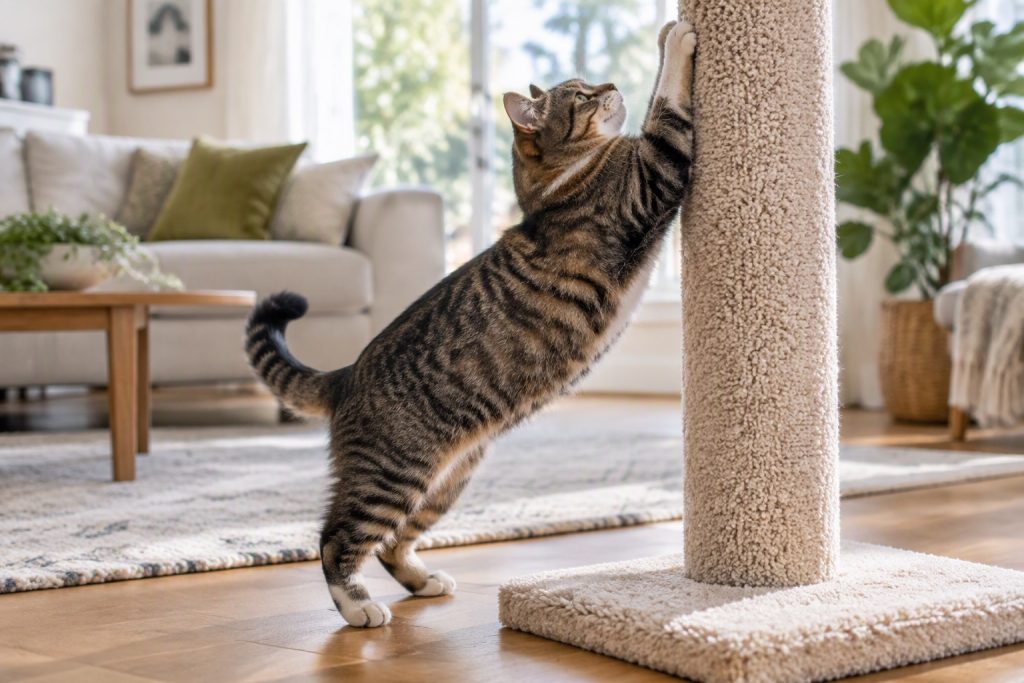
The best carpet scratching post is a tall, stable post covered in a material your cat actually wants to scratch, placed where she already scratches. For a cat who targets carpet, a carpet-covered post or a horizontal carpet pad often works best, because it matches the texture she has chosen. Look for a post tall enough that she can stretch to full height, a wide base or wall fixing so it does not wobble, and a covering that is tight enough not to unravel. Stability and placement matter more than size or price.
- Tall enough to stretch to full height.
- Very stable, with a wide base or wall fixing.
- Carpet covering suits cats who scratch carpet.
- Place it where she already scratches.
Why choose a carpet scratching post?
Carpet is a popular scratching surface for cats because the looped or tufted fibres grip the claw and give a satisfying resistance, which helps a cat shed the outer sheath of each claw. If your cat has been scratching your carpet, a carpet-covered post matches the texture she has already chosen, which makes the transition far easier than offering a different material. Carpet also offers a comfortable, textured surface for the full-body stretch that accompanies scratching, and it is often available in tall posts that suit a cat’s natural reach. The main downside is that some owners worry a carpet post teaches a cat that all carpet is fair game, so it is worth placing the post carefully and supervising early on. For many cats, though, a carpet post is the fastest route to moving the behaviour off your floor and onto something designed for it. Our article on the best cat scratching post compares materials more broadly.
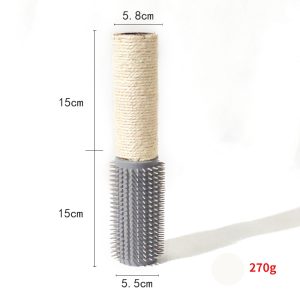
Sisal-wrapped post with a grooming brush base. Made from mixed materials. Made for scratching and stretching. Gives claws…
What makes a carpet scratching post stable and durable?
Stability is the single most important quality, because a post that wobbles or tips will be rejected. Look for a wide, heavy base, or a design that fixes to the wall, and check that the post does not sway when pushed. Height matters too: a good post lets your cat stretch to her full length with her front paws at the top, which is usually at least sixty to eighty centimetres for an average adult cat, and taller for a large cat. The covering should be tightly fixed, because loose carpet that shifts or unravels will put a cat off and look shabby quickly. Check the seams and how the carpet is attached, since glue that peels or staples that protrude are both hazards. Finally, consider a post with a platform on top, which adds value as a resting spot and makes the structure feel like furniture rather than a toy.
Where should I put a carpet scratching post?
Placement is the difference between a used post and an ignored one. Put it right where your cat already scratches, overlapping or adjacent to the spot, because cats scratch in socially important places and are unlikely to travel to a post hidden in another room. If she scratches the carpet by a doorway, put the post there. If she scratches the side of the sofa, place a vertical post beside it. In a multi-cat home, provide several posts in different areas so no cat has to compete. Cats often scratch after waking or when entering a room, so placing posts near sleeping spots and room entrances works well. Once she is using the post reliably, you can move it a few centimetres at a time if you want it elsewhere, but expect to keep a post near the original spot. Our guide on getting your cat to use a scratching post covers training in detail.
How do I get my cat to use the new post?
Make it appealing and familiar. Rub the post with catnip or silvervine, and play with her around it so she associates it with good things. Scratch the post yourself with your nails to show her the texture and sound, which often sparks her interest, and reward her with praise or a treat whenever she uses it. If she ignores it, try placing it exactly where she currently scratches rather than somewhere convenient for you. Some cats prefer a horizontal surface, so a flat carpet pad laid over the target area can be a better first step, with a vertical post introduced nearby. If she scratches the carpet beside the post, cover the carpet there with tape or a mat for a few weeks, so the post becomes the only satisfying option. Be patient and never punish her for scratching the carpet, which increases stress and makes marking worse.
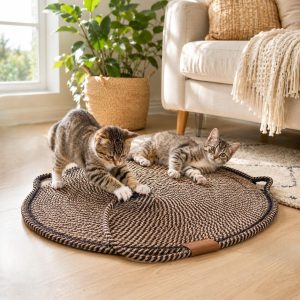
Woven cotton rope pad in an oval shape. Made from mixed materials. Made for scratching and stretching. Gives…
Are there downsides to carpet scratching posts?
A few, and they are manageable. The main concern is that a carpet post can blur the line between “scratch this” and “scratch all carpet,” so some owners prefer sisal or cardboard for that reason. Carpet also wears, and a cheaply covered post can unravel into long strands that a cat may chew or swallow, so inspect it regularly and trim or replace loose threads. Loose fibres can also be ingested, which is a risk for cats who chew. Carpet holds dust and dander more than smooth materials, so it needs vacuuming. Finally, some cats simply prefer a different texture once offered, so if your cat ignores the carpet post, try sisal or cardboard rather than assuming she will not scratch a post at all. Matching texture is a starting hypothesis, not a guarantee, so be ready to adapt.
How do I maintain a carpet scratching post?
Maintenance keeps the post appealing and safe. Vacuum the carpet covering regularly to remove dust, fur, and dander, and check the surface for loose threads, tears, and exposed staples or nails. Trim any long strands rather than pulling them, because pulling can unravel the covering further. If the post has a replaceable carpet sleeve, swap it when it becomes worn or matted, since a flat, exhausted surface is less satisfying to scratch. Tighten any bolts or fixings periodically, because a post that has become slightly loose will start to wobble and lose its appeal. If the base is carpeted too, check the underside for wear. Replace the whole post when the frame becomes unstable, since a wobbly post is worse than no post at all. A well-maintained post lasts for years and keeps your cat’s scratching off your floor and furniture.
Frequently asked questions
- Is a carpet post better than sisal? It depends on your cat. Carpet suits cats who already scratch carpet; sisal suits many others.
- How tall should a scratching post be? Tall enough for your cat to stretch fully, usually at least sixty to eighty centimetres.
- Why does my cat ignore her carpet post? It may wobble, be in the wrong place, or be the wrong texture. Fix stability and placement first.
- Does a carpet post teach my cat to scratch the carpet? It can blur the line, so place it carefully and cover the target carpet area during training.
- How do I keep a carpet post from unraveling? Choose a tightly covered post, trim loose threads, and replace worn sleeves rather than pulling them.





