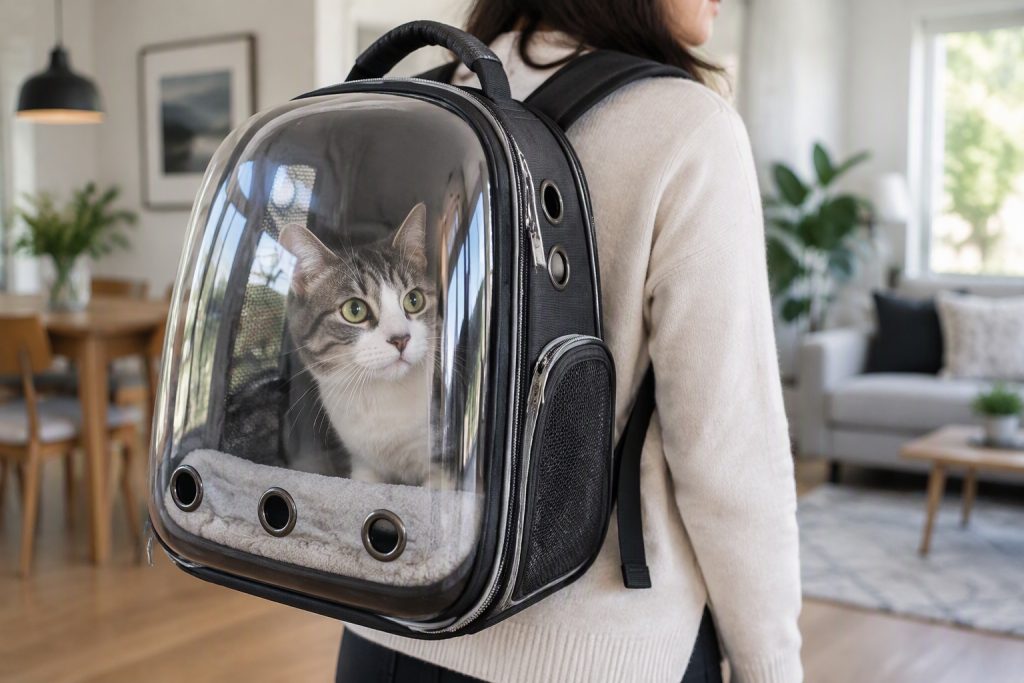
A cat carrier backpack can work well for calm, well-socialised cats on short, low-stress outings, but it is not automatically kinder than a standard carrier. The best backpack has rigid structure so it does not collapse, generous mesh ventilation on at least two sides, secure zips with locking clips, and a padded back and straps for you. For vet visits and air travel, a conventional carrier is usually the safer and more comfortable choice.
- Backpacks suit calm cats on short outings.
- Insist on rigid structure and mesh on two sides.
- Locking zips prevent escape in a panic.
- Use a standard carrier for vets and flights.
Is a carrier backpack good for cats?
It depends on the cat and the journey. A backpack keeps your hands free, positions your cat close to your body, and can be less bulky than a shoulder carrier on a crowded train or a walk. For a confident cat who is used to handling and enjoys watching the world, a backpack can be a pleasant way to travel. For a nervous cat, however, being carried at hip height with limited visibility can be more stressful than a stable carrier held in front of you, where she can see you. Backpacks also get warm, and a cat pressed against your back in summer can overheat quickly. As a rule, a backpack is a good option for short, low-stakes outings and a poor one for a frightened cat or a long journey. Our guide on cat carriers for airline travel covers what airlines actually require.
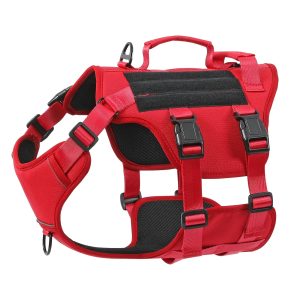
A fabric and Oxford cloth harness stays close enough that a cat cannot back out of it. Take…
What should I look for in a cat carrier backpack?
Structure comes first. A backpack that sags or folds inwards gives your cat nothing to brace against, so look for a rigid frame or reinforced panels that hold their shape. Ventilation is the next essential: mesh should cover at least two sides, ideally three, so air moves through rather than trapping heat. Zips need to be robust and, critically, lockable, because a panicked cat can nose open an unsecured zip and escape. Look for a safety tether inside to clip to a harness, and an internal base that is flat and firm, with a removable, washable liner. The straps should be padded and adjustable, with a chest strap to spread the load, and the whole pack should be comfortable when loaded. Finally, check the weight limit and that the bag does not flex when your cat moves around inside it.
How do I choose the right size?
Your cat needs to stand up, turn around, and lie down comfortably, which is more space than many backpacks offer. Measure her from nose to the base of her tail, and from the floor to the top of her head when standing, then add a few centimetres of clearance in each direction. A backpack that is too small forces her into a crouch and makes her feel trapped, while one that is far too large lets her slide around on every step. Weight capacity matters too, since a cat plus the bag can be heavier than expected on a long walk. Check the height of the internal space, not just the length, because many packs are long but shallow. If your cat is large or long-bodied, a soft-sided backpack may simply not be big enough, and a rigid carrier is the better answer.
How do I get my cat used to a backpack?
Introduce it at home, well before you need it. Leave the backpack open on the floor with a familiar blanket and a few treats inside, and let your cat explore it on her own terms. Feed her near it, then inside it, so it becomes associated with good things. Once she is comfortable entering, close it briefly while she is relaxed, then open it and reward her, building up the time gradually. Next, lift it a few centimetres and put it down, then carry it around the room, then step outside for a minute. Never force her in or zip it shut on a frightened cat, which can set training back weeks. A cat who panics in the pack is not ready for a walk. Our article on travelling with a cat covers the wider preparation, including harness training and short car trips.

Bundle of multicoloured printed leashes. Made from fabric. Made for walks, travel and everyday wear. Keeps your cat…
Are backpacks allowed on planes?
Sometimes, but the rules are strict and vary by airline. Most carriers that accept cats in the cabin require a soft-sided bag that fits under the seat in front of you, and the dimensions are usually specified in centimetres and checked at the gate. Many backpacks are too tall to fit under a seat, so a backpack that works on a bus may be refused at the airport. Airlines also typically limit one pet per passenger, require advance booking, charge a fee, and ask for vaccination and health documentation. Some airlines do not accept pets in the cabin at all. Always check the specific airline’s current policy directly before buying a bag, and confirm the dimensions against their published limits. If you plan to fly, choose a carrier that meets the airline’s under-seat size first, and treat the backpack feature as a bonus rather than the deciding factor.
How do I keep my cat safe in a backpack?
Safety comes down to escape prevention, temperature, and duration. Use the internal tether to clip your cat’s harness to the bag, and check that every zip is locked before you set off. Never carry a cat in a backpack with the top open, even for a moment, because a startled cat can move faster than you expect. Watch the temperature: a backpack pressed against your back traps heat, so avoid carrying your cat in hot weather, and check on her often, since panting or restlessness means she is too warm. Keep outings short at first, and stay in quiet places away from traffic, dogs, and crowds. Never leave a cat unattended in a backpack, and never use one as a substitute for a secure carrier in a car, where a soft bag should be buckled in or secured on the floor behind a seat. If your cat shows signs of distress, go home. It is also worth remembering that a backpack is not a substitute for a secure carrier in a car, where a soft bag should be buckled in or placed on the floor behind a seat so it cannot become a projectile in a sudden stop.
Frequently asked questions
- Are cat backpacks cruel? No, if the cat is comfortable and the pack is well ventilated, but a nervous cat may find a standard carrier less stressful.
- Can I use a backpack for vet visits? It is possible, but a rigid carrier is usually easier for the vet to examine your cat in.
- Do backpacks get too hot for cats? They can, so avoid hot days and check your cat regularly for panting or restlessness.
- What size backpack does my cat need? One where she can stand, turn, and lie down, with a few centimetres of clearance.
- Will an airline accept my cat backpack? Only if it meets the under-seat dimensions the airline specifies, so check before you buy.