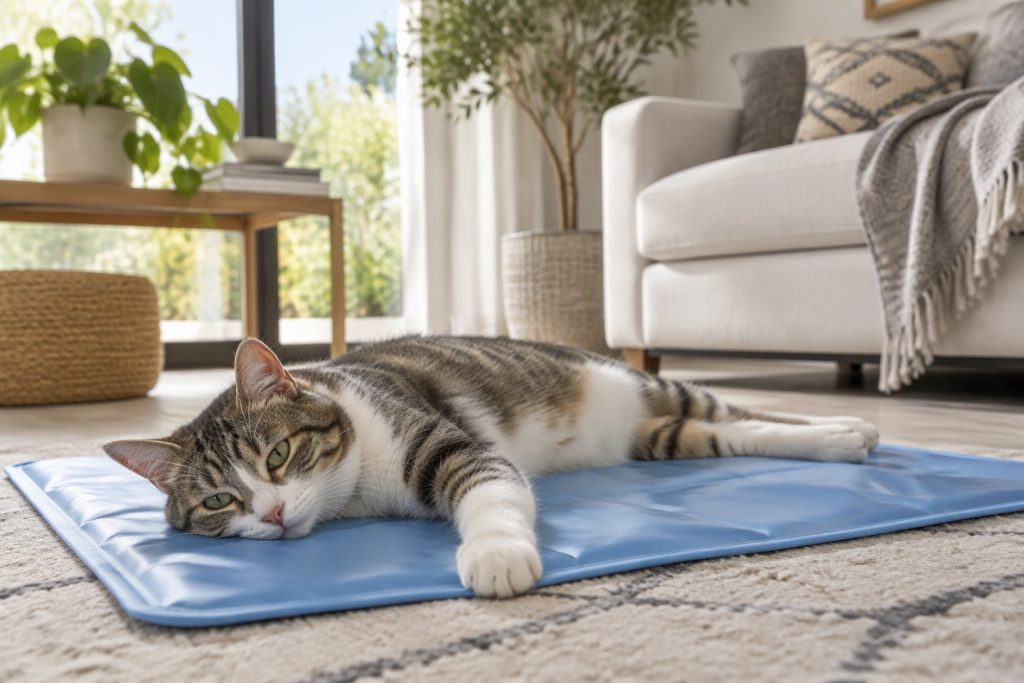
The best cooling mat for a cat is one that stays genuinely cool for a useful stretch of time, lies flat without sliding, and is safe if your cat decides to chew a corner. Pressure-activated gel mats and water-filled mats suit most homes, while a self-cooling pad that needs no refrigeration is the most convenient. Look for a non-toxic filling, a wipe-clean cover, and a size that lets your cat stretch out fully rather than perch.
- Pressure-activated gel mats cool without electricity.
- Check the filling is non-toxic and chew-safe.
- Choose a size your cat can stretch out on.
- Always offer a normal warm bed as a choice.
How do cooling mats for cats actually work?
Most cat cooling mats fall into three groups. Pressure-activated gel mats contain a cooling gel that absorbs body heat and releases it slowly, so the surface feels cool the moment your cat lies down. Water-filled mats work on a similar principle but need filling and can be punctured. Refrigerant mats, sometimes called ice mats, are chilled in the freezer and stay cold for a while but can feel too cold at first and warm up within an hour or two. A fourth option is an elevated mesh cot, which does not chill actively but allows air to circulate underneath and is very popular with cats. The right choice depends on your climate, how long your cat tends to settle, and whether she is likely to chew. In most homes a pressure-activated mat is the simplest and most reliable.
A thickened cloth bed is stepped into rather than climbed over. Try it near the window first, then…
What should I look for in a cat cooling mat?
Start with safety, because a cat who chews can puncture a mat and ingest the contents. Choose a mat with a non-toxic filling and a durable outer layer, and check for a puncture-resistant build. Next, consider size: cats prefer to stretch out fully when hot, so a mat that is too small will be ignored, and a generous rectangle usually beats a small circle. Look for a non-slip base so it does not skate across a hard floor when she jumps on. A wipe-clean, removable cover makes hygiene far easier, especially in a house with several cats. Think about cooling duration too: if your cat naps for hours, a freezer mat that warms in ninety minutes will not last. Finally, check that it lies flat and has no sharp seams or strong chemical smell when new.
Do cooling mats actually help cats in hot weather?
They can help, but they are one tool rather than a cure. Cats do not sweat like people, and they rely on panting, grooming, and finding cool surfaces to manage heat, so offering a cool spot genuinely supports them. A mat gives a cat a deliberate, cool place to lie, which can reduce the time she spends sprawled on tiles or in a sink. That said, a mat cannot cool a room, and it will not protect a cat in real heat stress. It works best alongside shade, good ventilation, plenty of water, and avoiding the hottest part of the day. If your cat is panting heavily, drooling, or seems weak, that is heatstroke and needs urgent veterinary care, not a mat. For everyday summer comfort, though, a cooling mat is a practical and inexpensive addition. For a fuller summer routine, our guide on keeping a cat cool in summer covers shade, ventilation, and water alongside cooling products.
Which cats benefit most from a cooling mat?
Cats who struggle in the heat benefit most: flat-faced breeds such as Persians and British Shorthairs, long-haired cats, older cats, overweight cats, and cats with heart or breathing conditions. Kittens and elderly cats regulate temperature less efficiently, so a cool resting place is especially valuable for them. Cats in hot, humid climates, or in homes without air conditioning, also gain a lot, as do cats recovering from illness or surgery. Even healthy adult cats often seek out cool surfaces in summer, and a mat simply gives them a better option than the kitchen floor. If you have more than one cat, consider two mats, since a cat who is displaced from the cool spot may become stressed. A cooling mat is not necessary for every cat, but it is a thoughtful addition for anyone who has watched their cat sprawl across tiles in July.

Cervical pillow, plush hammock, floor mat and paw cushion — four places to nap. Gives a cat a…
Are cooling mats safe for cats?
They are safe when used sensibly, but a few precautions matter. Never use a mat that has been punctured or is leaking, because the filling may be harmful if swallowed, and dispose of damaged mats promptly. Check the label for a non-toxic, pet-safe filling, and avoid anything with a strong chemical odour. Do not leave a freezer mat in direct sun, and never microwave one unless the manufacturer explicitly says it is microwave-safe. Supervise the first few uses, especially with a cat who chews fabric, and put the mat away if she starts biting it. Some cats dislike the cold sensation, so never force the issue: place the mat nearby and let her choose. Always keep a normal, warm bed available too, because a cat who cannot escape a cold surface may become uncomfortable. If your cat is unwell, ask your vet before relying on cooling products. It is also worth checking the mat for wear each time you use it, since repeated folding can crack the inner layer and start a slow leak that is easy to miss until your cat is lying in a puddle of gel.
How do I get my cat to use a cooling mat?
Cats are suspicious of new objects, so introduction matters. Put the mat down in a spot she already likes to rest, such as near a window or on her favourite chair, rather than in an unfamiliar corner. Let her investigate at her own pace, and never place her on it. You can speed acceptance by putting a thin, familiar blanket or one of your worn t-shirts over it at first, then removing the cover once she is comfortable. A light sprinkle of catnip or a few treats on the surface helps some cats. If she avoids it entirely, try a different type, such as an elevated cot instead of a gel mat, since some cats prefer airflow to a cold surface. Give it a week of quiet availability before deciding it has failed. Our guide on cooling mats for cats compares the main types.
Frequently asked questions
- Do cooling mats need electricity? Most pressure-activated gel mats do not; only some fan-assisted or chilled models do.
- How long does a cooling mat stay cool? A gel mat stays cool as long as your cat lies on it; a freezer mat typically lasts one to two hours.
- Can my cat chew a cooling mat? She can, which is why a non-toxic filling and puncture-resistant cover matter.
- Is a cooling mat enough in a heatwave? No. Pair it with shade, ventilation, and water, and watch for signs of heatstroke.
- My cat ignores the mat. What now? Move it to a spot she already likes, cover it with a familiar blanket, and try an elevated cot instead.