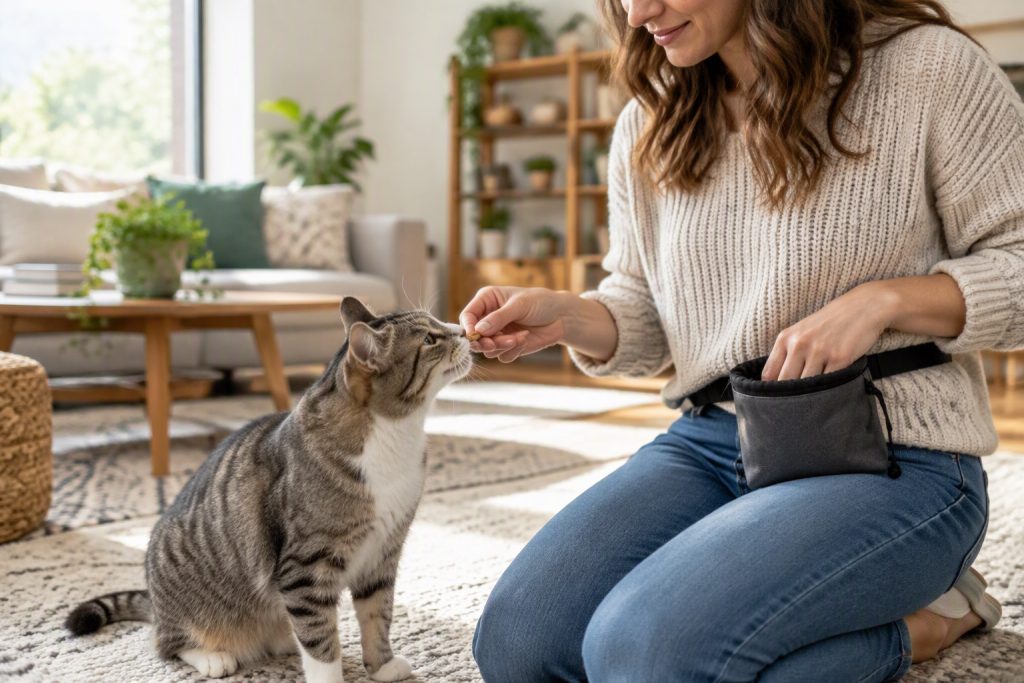
A good cat treat pouch is one you can open and close with one hand, that seals well enough to keep treats fresh, and that attaches securely to your waist or a belt. For training, the most useful design has a wide, rigid mouth so you can grab a treat without looking, plus a clip that stays put when you move. Size should match your session, not your whole treat supply.
- One-handed open and close is essential.
- A wide mouth lets you grab treats without looking.
- Clip it to a belt so it stays put.
- Match the size to one training session.
What makes a good cat treat pouch?
The single most important feature is one-handed operation. During training, your other hand is holding a toy or a target, and you cannot fumble with a zip. Look for a pouch with a wide, rigid opening that stays open on its own, so you can reach in without looking, and a closure that snaps shut quickly. A moisture-resistant lining keeps treats from going stale or greasy, and it makes cleaning far easier. The attachment matters too: a strong belt clip, a carabiner, or a waist strap that does not slip as you crouch and move. A second compartment or a small mesh pocket is useful for a clicker, a target stick, or a spare toy. Above all, it should be comfortable to wear for fifteen minutes at a time. Our guide on the best treats for training pairs well with the right pouch.
Clear glass bowl holding dry food. Made from plastic. Made for daily feeding and fresh water. Keeps food…
How big should a training pouch be?
Small is usually better than large. A pouch that holds only the treats you need for one session, roughly a small handful, keeps them fresh and prevents you from overfeeding during training. A cat’s training treats should be tiny, pea-sized or smaller, and counted as part of her daily calories, so a large pouch invites over-treating. A capacity of around 250 to 500 millilitres suits most owners, with a wide mouth that makes the contents easy to reach. If you train outdoors for long sessions, a slightly larger pouch with a sealable lid helps, but it should still be light enough not to pull at your waistband. A pouch that is too deep makes you dig for treats, which slows your timing, and timing is everything in training. Choose based on the length of a typical session, not the size of the treat bag.
Should a pouch be hands-free?
Yes, and this is what separates a treat pouch from a treat container. A hands-free pouch clips to your waistband, a belt, or a strap, so both hands stay free for a wand toy, a target stick, or a clicker. That matters because training depends on precise timing: if you have to reach for a pocket or set something down to get a treat, the reward arrives late and your cat cannot connect it to the behaviour. A waist-worn pouch also keeps treats close to your body, which means you can deliver a reward within a second of the correct action. Look for an adjustable strap so the pouch sits where your hand naturally falls, and a clip that will not detach when you bend down. A shoulder strap is a reasonable alternative, but a waist clip is generally faster and more secure.
How do I keep treats fresh in a pouch?
Use a pouch with a moisture-resistant lining and a closure that actually seals, and empty it after every session rather than leaving treats in it for days. Soft treats, which are usually the most motivating, dry out quickly once exposed to air, so seal them between uses and store the rest in an airtight container. Hard treats keep longer but are often less compelling for training. Avoid putting moist food or raw meat in a fabric pouch, since it will soak in and harbour bacteria. In warm weather, keep sessions short and do not leave treats in a hot car or in direct sun. If you use a mix of treats, put the high-value ones in the main compartment and the ordinary ones in a side pocket. Wash the pouch regularly so old crumbs do not go stale or mouldy. Our article on how to stop a cat biting shows how reward-based training uses treats well.
Nail scissors, bath brush, de-shedding glove and a drying towel — the full groom in one box. Cuts…
How do I use a pouch for training?
Wear the pouch on the side of your dominant hand, so the reach is natural, and pre-load it before you start. Cut treats into tiny pieces, since small rewards let you repeat the behaviour many times without filling your cat up. Keep the pouch sealed between rewards, because a cat who can smell an open bag will focus on the bag rather than on you. Deliver the treat quickly after the correct behaviour, ideally within a second, and pair it with a marker word or a click so your cat knows exactly what earned the reward. Work in short sessions of two to five minutes, and end while your cat is still engaged. Use the side pocket for a clicker so your hands stay organised. If you are training a cat who bites or grabs, drop the treat rather than handing it over, and keep your fingers out of the way.
How do I clean a treat pouch?
Empty it after every session and wipe the lining with a damp cloth, then let it dry fully with the mouth open. Most lined pouches can be hand-washed in warm water with a mild soap, but check the manufacturer’s instructions before machine washing, since clips and straps can be damaged. Rinse thoroughly, because soap residue will put your cat off the treats. Turn the pouch inside out to dry so air reaches the corners where crumbs collect. If the pouch has a fabric exterior, spot-clean it rather than soaking it. Avoid harsh disinfectants, which can leave a smell that lingers on treats. Replace the pouch if the lining cracks, the clip loosens, or it develops a persistent smell, because a pouch that will not seal cleanly is no longer doing its job. A quick rinse after each session keeps it fresh for months. If you train outdoors, keep the pouch out of direct sun and avoid leaving treats in a hot car, since warmth speeds up spoilage and a pouch that smells off will put your cat off the reward entirely.
Frequently asked questions
- Do I really need a treat pouch for cat training? No, but it makes one-handed reward delivery far faster, which improves training results.
- What size treat pouch is best? One that holds a single session’s worth of tiny treats, usually a small handful.
- Can I use a dog treat pouch for my cat? Yes. The design is the same, though you will want smaller treat pieces for a cat.
- How do I stop treats going stale in a pouch? Choose a sealed, moisture-resistant lining and empty it after every session.
- Are soft or hard treats better for training? Soft, smelly treats are usually more motivating and quicker for a cat to eat.