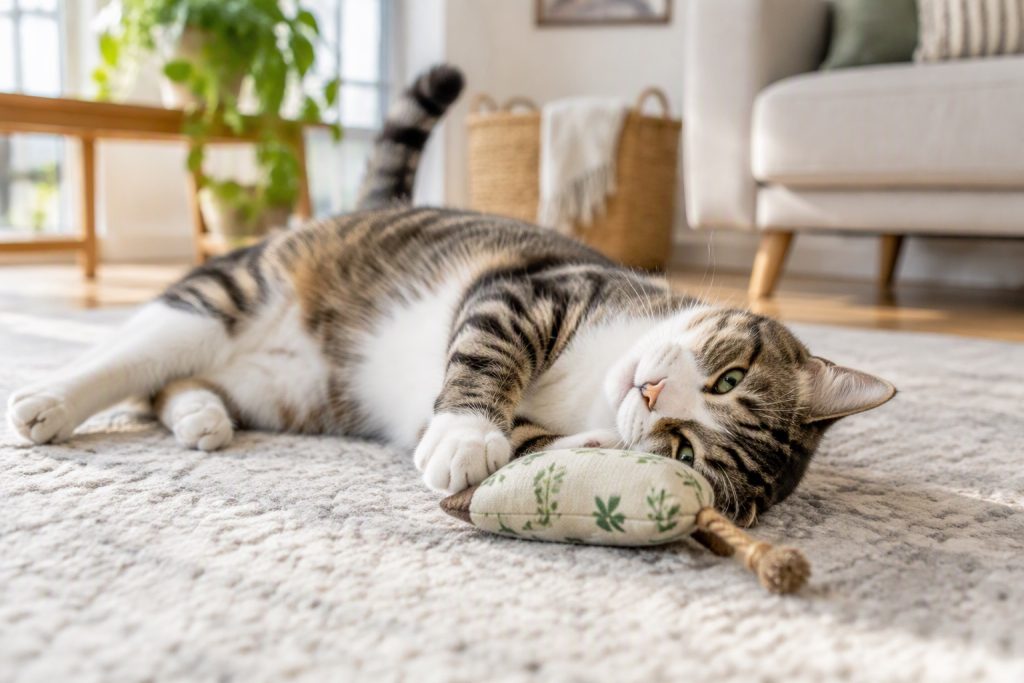
Catnip is a herb whose oils, mainly nepetalactone, trigger a temporary behavioural response in many cats by acting on receptors linked to scent. Affected cats may sniff, lick, roll, rub, or zoom for a few minutes, then lose interest. It is not a drug, it is not harmful, and roughly a third of cats do not react at all.
- Catnip is a safe herb, not a drug.
- It affects cats through their sense of smell.
- Reactions last only a few minutes.
- About a third of cats are unaffected.
What is catnip and how does it work?
Catnip is a member of the mint family, and its active compound, nepetalactone, is concentrated in the leaves and stems. When a cat sniffs it, the compound binds to receptors in the nose that normally respond to certain pheromones, which is why the response looks a lot like a cat reacting to a social scent. The result can be sniffing, licking, chewing, rolling, rubbing, head-shaking, or a burst of playful energy, and it usually lasts around five to fifteen minutes before the cat loses interest for a while. Some cats become relaxed and floppy instead of lively, and a few become mildly aggressive, which is worth watching. The effect is behavioural and short-lived, not addictive, and the cat’s brain returns to normal once the scent fades. It is a genuinely harmless bit of enrichment for most cats. Because the reaction is triggered through the nose rather than the bloodstream, it wears off naturally and leaves no lasting effect.
A corrugated paper scratcher fits beside a door without blocking the walkway. Site it near the door the…
Is catnip safe for cats?
Yes, catnip is considered safe for cats, and there is no known toxicity at normal exposure. Cats cannot overdose on it in the way they might with a medication, and the worst outcome of too much is usually a short spell of over-excitement or a slightly upset stomach if they eat a large amount of the dried herb. That said, a cat who becomes aggressive or overly aroused on catnip is better off without it, and it should never replace real play or social contact. Some owners worry that catnip is a drug, but it is a plant that triggers a scent response, and it wears off on its own. If your cat has a medical condition and you are unsure, it is reasonable to check with your vet, but for the vast majority of healthy cats it is a safe and enjoyable treat. Kittens and some adults simply show no interest, and that is entirely normal rather than a sign of anything wrong.
Why do some cats not react to catnip?
The response to catnip is inherited, and studies suggest that a substantial minority of cats, often estimated at around a third, simply do not have the genetic sensitivity to react. Kittens under a few months old usually ignore it as well, and sensitivity tends to develop as they mature. A non-reacting cat is not broken or unhappy; she just cannot smell what the others can. If your cat falls into this group, alternatives such as silver vine, valerian, or honeysuckle toys often produce a similar response, because they contain different compounds that some cats do respond to. There is no way to train a cat to react to catnip, so the practical answer is to try a few options and see what, if anything, your cat enjoys. Many cats are perfectly content with ordinary toys instead. Try each alternative in a small amount first, and give it a few sessions before deciding whether your cat responds.
How much catnip is too much?
For most cats, there is no strict limit, because the effect is self-limiting: once the scent fades or the cat has had enough, she simply walks away. A small pinch of dried catnip, a spray on a toy, or a stuffed toy is plenty for a single session, and giving more does not deepen the experience. Very large amounts eaten at once can cause mild digestive upset, so it is sensible not to leave a big open bag where your cat can gorge on it. Offering catnip every day can also reduce its novelty, so many owners find it works best as an occasional treat rather than a constant presence. Rotate it in every few days or use it when you want to encourage interest in a new toy, scratching post, or carrier. Less, used well, tends to be more effective than a constant supply. Store catnip in an airtight container away from light, since the oils fade over time and stale catnip loses its appeal.

Rainbow-striped plush cylinder. Keeps a bored indoor cat busy and burns off restless energy. Made from fleece and…
Does catnip have any real benefits?
Catnip is not medicine, but it does have genuine practical uses as an enrichment tool. It can encourage a shy or sedentary cat to move, play, and explore, which supports both physical and mental health, and it can help a cat warm to a new bed, scratching post, or carrier. For cats who need more activity, a catnip session is a gentle way to prompt movement, and our guide to how much play an indoor cat needs explains how to build that into a daily routine. It can also be a small comfort during stressful changes, though it is not a substitute for addressing the source of stress. The main benefit is simple enjoyment: a few minutes of rolling, rubbing, and playing brightens an indoor cat’s day. Used thoughtfully, it is a cheap and safe addition to your enrichment toolkit rather than a cure for anything.
How do I use catnip to help my cat?
Use it deliberately rather than scattering it everywhere. Rub a little dried catnip or spray a catnip solution onto a new scratching post, bed, or toy so your cat investigates and claims it, which is especially useful when you want her to switch from the sofa to a proper post. For a bored or under-active cat, offer catnip before a play session to spark interest, then follow through with a wand toy so the energy goes somewhere useful. Keep the bag sealed and stored away from light to preserve the oils, since old catnip loses its potency. If your cat becomes over-aroused or aggressive, stop and give her space. Some cats also vocalise more after catnip, and our article on why cats meow so much can help you tell excitement from distress.
Frequently asked questions
- Is catnip a drug? No. It is a herb whose scent triggers a harmless behavioural response, and it is not addictive.
- At what age do cats respond to catnip? Most cats develop sensitivity as they mature, and kittens under a few months old usually ignore it.
- How long does catnip last? A single reaction typically lasts five to fifteen minutes, after which most cats lose interest for a while.
- Can catnip make my cat sick? Eating a very large amount may cause mild stomach upset, but it is not toxic at normal exposure.
- What if my cat ignores catnip? She may be genetically insensitive to it. Try silver vine, valerian, or honeysuckle as alternatives.