

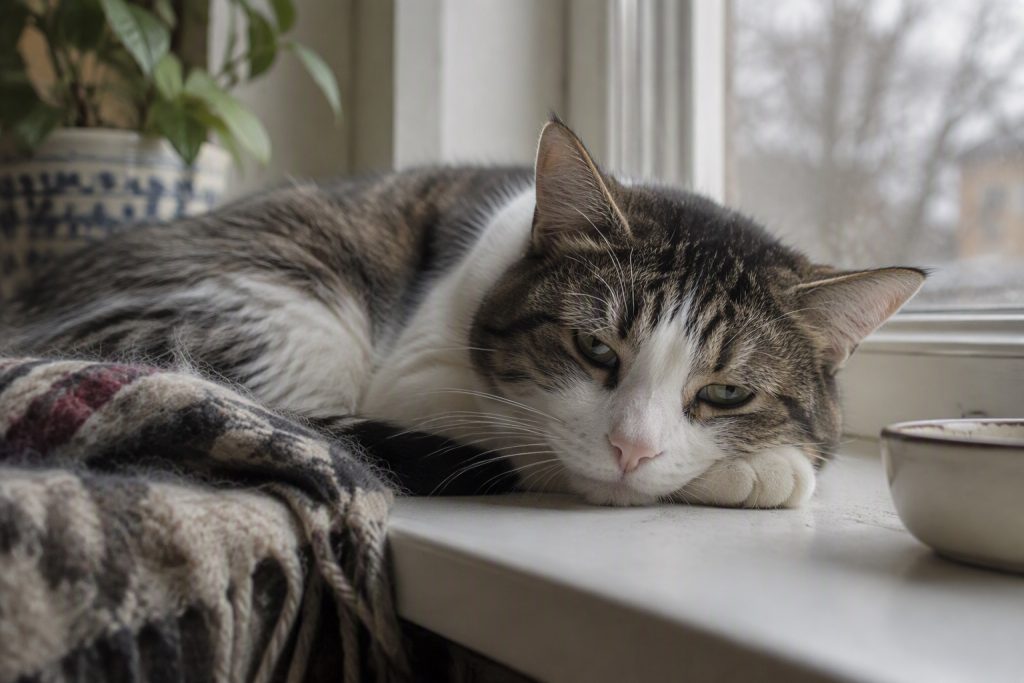
Cats hide illness because in the wild a cat that looks unwell becomes a target, and the instinct to mask pain, weakness and nausea persists even in a cat that has never hunted anything. That is why owners so often say the cat seemed fine until the day it was not. By the time a cat shows obvious signs, the problem is frequently well advanced. The practical consequence is that subtle changes matter more than most people realise: a shift in appetite, a new sleeping spot, a coat that looks different, or a cat that quietly stops jumping onto the chair it used to claim every evening.
- Cats instinctively mask pain and illness, so obvious symptoms often appear late.
- Small changes in routine, appetite, grooming or jumping are frequently the first real signal.
- A cat that hides more, eats less or abandons its usual spots should be checked by a vet.
- Do not wait for dramatic symptoms before booking an appointment.
Why do cats hide illness so effectively?
Because showing weakness is a liability for a small predator that is also prey. A cat in the wild that limps, cries or lies apart from its group becomes conspicuous, so the ones that mask discomfort best survive. Domestic cats have kept the behaviour even though nothing is hunting them. They also have an unusually high tolerance for discomfort, and they are masters of small compensations: shifting weight off a sore leg, eating more slowly to avoid a painful tooth, sleeping more to conserve energy. Each individual adjustment is easy to miss, and together they add up to a cat that looks fine right up to the point where it cannot compensate any more. This is why a change in habit is often the only early warning available.

Grey house-shaped bed with a cat. Made from mixed materials. Made for everyday resting. Gives a cat a…
What are the earliest signs a cat is unwell?
The earliest signs are usually behavioural rather than physical, which is exactly why they are overlooked. Watch for a cat that sleeps more or in different places, eats less enthusiastically, leaves food in the bowl, drinks more or less, grooms less or in one spot only, or stops jumping onto high surfaces. A cat that no longer greets you at the door, that sits facing a wall, or that becomes unusually clingy or unusually withdrawn is telling you something. Subtle changes in the litter box are also important, including different stool, more or less urine, or a cat that takes longer than usual. None of these proves illness on its own, but a cluster of them, or one that persists for more than a few days, is a reason to book a check-up rather than to wait.
Why does a sick cat hide?
For the same reason it masks pain: hiding is protective. A cat that feels vulnerable will find somewhere enclosed, quiet and defensible, often somewhere it has never chosen before. Owners frequently read this as sulking or as a reaction to a household change, and sometimes it is. But a cat that hides persistently, especially under a bed or in a wardrobe, and stays there past mealtimes, is often in discomfort rather than in a mood. The posture matters too. A cat in pain often crouches with its head lowered and its eyes partly closed, and may resist being touched on a particular area. If hiding is new and lasts more than a day, treat it as a health question rather than a behavioural one, as covered in why cats hide.
What changes should make me call the vet?
Call a vet if the cat stops eating for more than a day, loses weight, vomits repeatedly, has diarrhoea that lasts more than a day, strains in the litter box, breathes differently, or becomes suddenly lame. Call the same day if the cat is crying out, hiding and unresponsive, breathing with effort, or unable to pass urine — a blocked male cat is a genuine emergency. Book a routine appointment for more gradual changes: a coat that looks dull or greasy, a cat that has slowed down, new bad breath, a change in thirst, or a senior cat that has become disoriented or vocal at night. Bring a note of what you have noticed and when it started, because that timeline is often more useful to a vet than a single observation on the day.

Deep red plush donut bed. Made from cloth. Supplied in light gray. Made for everyday resting. Gives a…
How can I tell pain from ordinary grumpiness?
Grumpiness is usually situational and reversible: a cat that hisses when you trim its claws but is relaxed an hour later is not in pain. Pain tends to be consistent and tied to movement or touch. Signs worth taking seriously include flinching when a particular area is stroked, reluctance to jump up or down, stiffness after resting, a tail that twitches when the hindquarters are handled, and a cat that stops grooming a spot it can no longer reach. A change in temperament in an older cat is often the first sign of arthritis or dental disease rather than a personality change. None of this can be diagnosed at home, and pain relief for cats is not something to guess at, because several human painkillers are toxic to them. A vet examination is the only safe route.
What can I do at home to notice problems earlier?
Weigh the cat regularly, because weight change is one of the most objective early signals and it is easy to track. Weigh yourself holding the cat, then subtract your own weight, or use a baby scale. A monthly record shows a trend a weekly glance cannot. Run your hands over the cat once a week: check the coat for lumps, scabs and matting, look at the gums, check the ears, and feel for tenderness along the spine and limbs. Watch it move at speed, because a cat that no longer runs or jumps is telling you something. Keep a simple note of appetite, litter box habits and any behaviour changes. Then, if something shifts, you have a baseline to describe to a vet. Senior cats benefit most from this routine, and behaviour changes in older cats deserve particular attention.
Frequently asked questions
- Can a cat be ill and still eat normally? Yes. Appetite often holds up until a problem is advanced, which is why weight and behaviour changes matter alongside how much the cat eats.
- My cat is hiding but seems fine otherwise. Should I worry? If the hiding is new and lasts more than a day or two, have it checked. Hiding is a common early sign of discomfort in cats.
- Do cats purr when they are in pain? They can. Purring is not a reliable sign of wellbeing, and some cats purr when stressed or uncomfortable as a self-soothing behaviour.
- How often should an older cat see a vet? Many vets suggest a check-up every six months for cats over about ten, because changes are easier to catch early.
- Should I wait to see if it passes? For appetite, litter box or breathing changes, no. Early assessment is usually simpler and cheaper than treating an advanced problem.


