

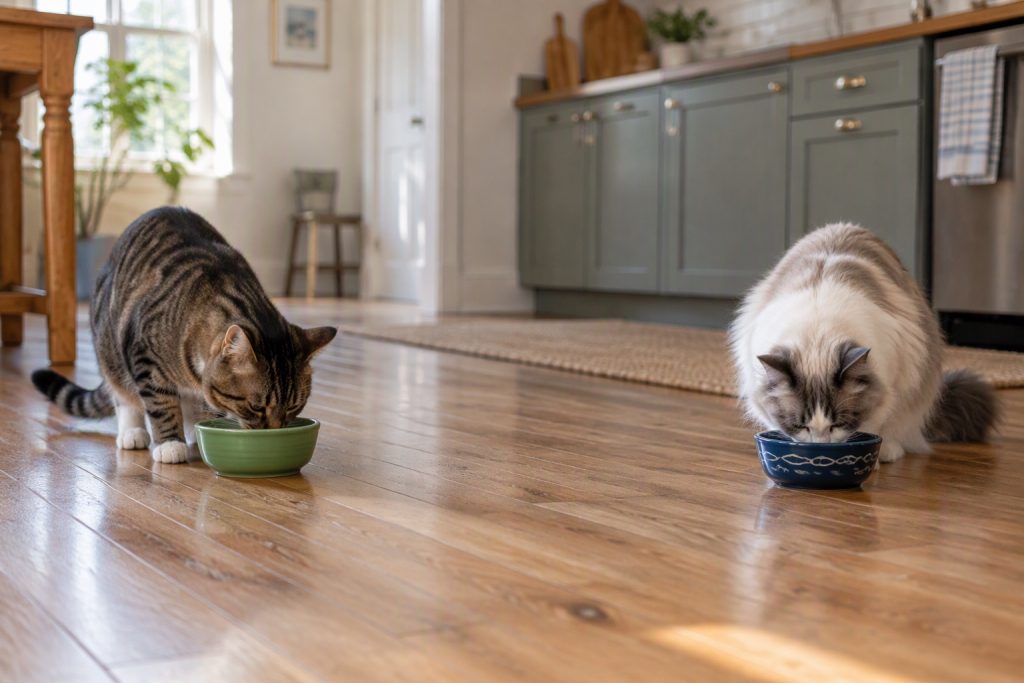
Feeding several cats is not simply a matter of putting down more bowls, because cats are solitary eaters by instinct and most would rather eat alone than share a meal with another cat watching. When food is placed close together, the more confident cat eats first and the less confident one waits, eats less, or stops eating altogether. Over time that shows up as weight loss in one cat, guarding behaviour, or tension that spills into the rest of the house. Separating the feeding stations properly solves most of it, and it costs nothing but a little planning and a few extra rooms.
- Cats generally prefer to eat alone, so bowls placed close together create competition.
- Feed in separate rooms or with a visual barrier, not just at opposite ends of one room.
- Pick the bowls up after the meal so there is nothing left to guard between meals.
- Weight loss or hiding at mealtimes in one cat is a welfare problem, not a manners problem.
How far apart should food bowls be for two cats?
Far enough that neither cat can see the other eating. In practice that usually means different rooms with the doors closed, or a hallway with a solid visual barrier between the two stations. Two bowls a metre apart in the same kitchen is not separation, it is a shared table, and it will produce the same competition as a single bowl. Distance matters less than sightline: a cat that can watch another cat while eating is a cat that feels it has to guard. If you cannot use separate rooms, a barrier that blocks the view works well, as does feeding one cat on a raised surface the other cannot reach. Some owners also feed one cat behind a closed door while the other eats in the kitchen, then swap. The point is that each cat eats without an audience.
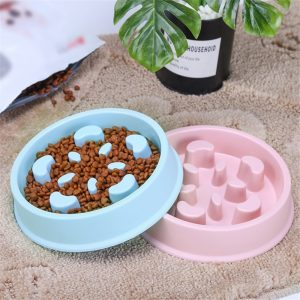
This slow feeder slows a cat down so a meal lasts longer — a meal that takes longer…
Why is one cat eating the other’s food?
Usually because the food is accessible and eating is rewarding, not because the cat is greedy. In a shared space, the faster or more confident cat finishes first and then moves to the other bowl, which the slower cat may abandon. The fix is to remove the opportunity rather than to police it: separate the stations, pick bowls up as soon as each cat finishes, and if necessary feed the fast eater behind a closed door while the slower cat eats in peace. Food stealing can also be a sign that one cat is not getting enough at its own meals, so weigh both cats and check that each is holding steady. If the pattern has been going on for a while, the cat that has been losing out may have lost weight, which is worth a vet check.
How do I feed cats different diets in the same house?
With physical separation and a routine the cats cannot defeat. If one cat is on a prescription diet and the other is not, the food must not be interchangeable, because the cat that needs the diet may end up eating the wrong food and the cat that does not need it may eat the medical diet. Feed in separate rooms with the doors closed, put the bowls down at set times, and lift them when the meal is over. If one cat is a slow eater, give it a quiet room and enough time. Microchip feeders, which open only for a specific cat, solve the problem neatly for dry food, though they take a little training to introduce. Never leave a prescription diet down for free access in a multi-cat home, because you cannot control who eats it.
Should I free-feed multiple cats?
Generally no, and this is one of the most common sources of quiet problems in multi-cat homes. A bowl that is always full cannot tell you who is eating and who is not, which means the earliest sign of illness in a cat — a change in appetite — is hidden from you. Free-feeding also makes it impossible to control portions, so weight gain creeps in, and it removes the mealtime structure that cats find reassuring. Scheduled meals are better for monitoring, better for weight control and better for multi-cat harmony, because each cat eats in a defined place at a defined time and then the food goes away. If your cats are used to grazing, transition gradually by offering meals at set times and reducing the amount left down between them.
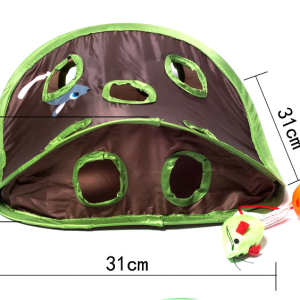
This rolling toy rolls and moves the way a cat's prey does — movement is the whole point.…
Can a slow feeder help with multi-cat meals?
It can, particularly when one cat bolts its food and then goes looking for more. A slow feeder makes the fast eater work for each mouthful, which stretches the meal out and gives the slower cat a chance to finish without being pushed off. It does not solve the underlying problem if the bowls are still side by side, so use it alongside separation rather than instead of it. A puzzle feeder can also help by turning a meal into an activity, which reduces the frantic pace and the post-meal begging that often follows. The combination that works for most homes is separate rooms, set meal times, and a slow or puzzle feeder for whichever cat eats fastest. If one cat is losing weight despite all of this, treat it as a medical question.
When is feeding conflict a health concern?
When one cat is consistently not getting enough. Watch for a cat that hangs back at mealtimes, hides while the other cat eats, or has started losing weight. Weigh your cats monthly, because weight is the most reliable measure of whether the arrangement is working. A cat that has lost weight or stopped eating needs a vet appointment rather than more bowls in more places, because weight loss in cats often signals an underlying condition. Guarding is also a welfare issue: a cat that cannot eat in peace is under chronic stress, which shows up elsewhere as hiding, spraying or litter box avoidance. Fixing the feeding setup is a high-value change in a multi-cat home, and resource conflict between cats covers the wider picture. Treat counts matter too, so how many treats a cat should have is worth checking.
Frequently asked questions
- Can two cats share one bowl? They can, but it creates competition and makes it impossible to know who is eating how much. Separate bowls in separate places are always better.
- How long should I leave food down? Around fifteen to thirty minutes for a scheduled meal, then lift it. Leaving food down invites guarding and hides appetite changes.
- My cats eat fine together. Do I need to change anything? If both cats are a healthy weight and neither is tense, your arrangement is working. Keep weighing them to be sure.
- Should I feed cats at the same time? Yes, but in separate places. A shared schedule with separate stations gives structure without competition.
- What if one cat needs to eat more slowly? Use a slow feeder or puzzle feeder for that cat in its own space, so it can eat at its own pace without pressure.


