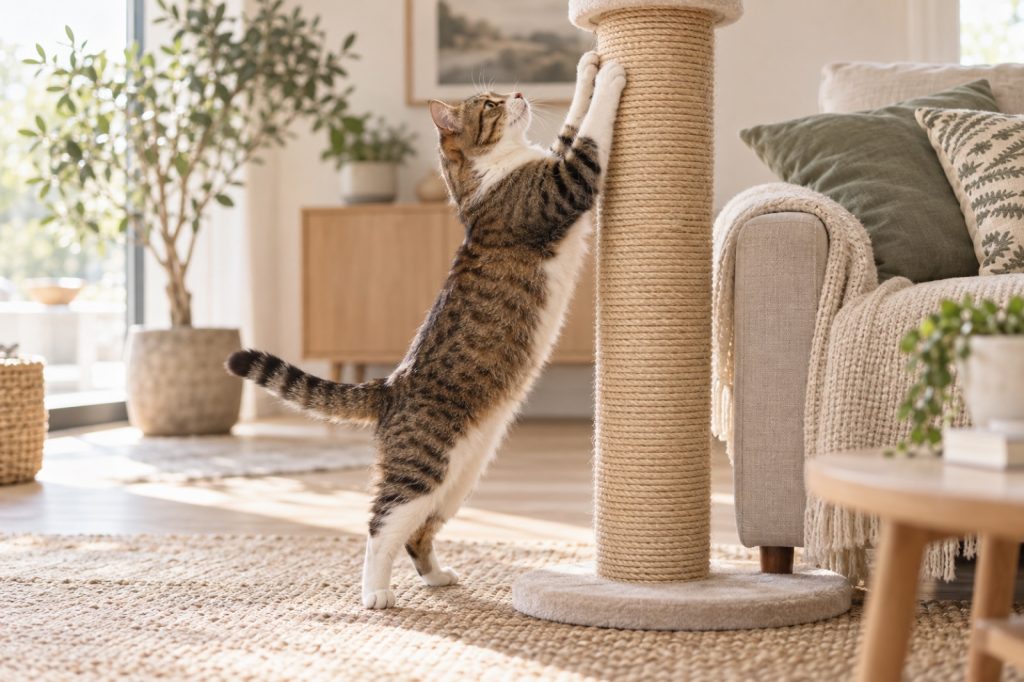
A scratching post gets used when it stands where your cat already scratches, stretches, and wakes up — usually right beside the sofa, near a favourite window, or next to her sleeping spot. Put it somewhere convenient for her, not tucked away in a spare room, and anchor it so it does not wobble. Location beats every other feature when you are trying to change scratching habits.
- Place it where she already scratches, not out of sight.
- Put one beside her sleeping spot for morning stretches.
- Anchor it firmly; a wobble puts cats off.
- Add a second post near the sofa if that is her target.
Where does a scratching post need to go to actually get used?
Think like a cat. She scratches where she spends time and where her scent matters most, which means the post has to sit inside her daily route, not in a room she visits twice a week. The highest-value spots are next to the piece of furniture she targets, beside her main sleeping area for that long wake-up stretch, and near a window or a doorway she patrols. A post in the corner of a spare bedroom is invisible to her, no matter how good it is. The principle is simple: put the post where the behaviour already happens, then let it absorb the scratching. Move it later only once she is reliably using it, and move it gradually so you do not lose the habit you just built. A post that sits in her path will get used almost by accident; a post she has to seek out will gather dust.
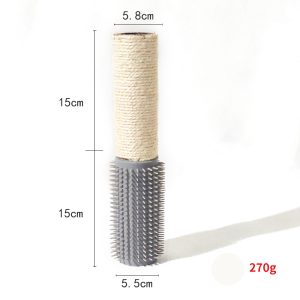
Sisal Scratching Post For Cats Scratching Device For Scratching The Face Sisal Toy Scratching Device. Part of the…
Should the post be near the sofa she already scratches?
Yes — this is the single most effective placement in most homes. A cat scratches the sofa because it is a large, stable, scent-marking surface in the middle of her territory. If you put a tall, sturdy post directly in front of or beside the scratched arm, you give her an equally satisfying surface in the same location, and cats usually switch to the easier, purpose-built option. Keep the post closer to her than the sofa is, so it is the first thing she meets. This is the same logic we unpack in our guide to why cats scratch the sofa. Once she is using the post reliably, you can nudge it a little to the side, but do not rush that step. Watch which part of the sofa she favours, because the arm, the back, and the seat get scratched for slightly different reasons.
How many scratching posts does one cat need?
One post is rarely enough, even for a single cat. Cats scratch to mark territory, so they want a surface in more than one zone — typically one near where they sleep, one near the main living area, and often one by a window or a hallway they patrol. The practical minimum for most homes is two posts per cat, and more if you have a large space or multiple cats. Horizontal scratchers matter too: some cats prefer to scratch flat surfaces, like a cardboard pad on the floor, rather than a vertical post. If you offer both orientations in a couple of locations, you cover almost every preference. Spread them out so no single post has to serve the whole house. In a two-cat home, add a post per cat per zone, so neither cat has to wait for a turn on the one good surface.
What height and material should the post be?
Height first: a post must let your cat stretch fully upright with her front paws extended overhead. For most cats that means at least 60 to 75 centimetres of scratchable surface, and taller is better. A short post forces her to scratch in a cramped, hunched position, which is not satisfying, so she returns to the sofa. Material second: sisal rope or a dense carpet wrap takes claws well and lasts. Avoid loose, looped fabrics that snag and unravel. Stability third: the base must be heavy and wide enough that the post does not tip or slide when she pulls. A wobbling post feels unsafe, and a cat will abandon it instantly. Test it yourself by pushing it at the height her shoulders reach, and brace it against a wall if it still moves.
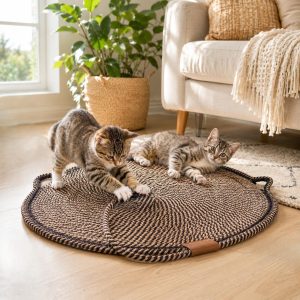
Cat Scratch Pad For Indoor Cats Kitten Round Cat Scratcher Pad, Woven Cotton Rope Cat Scratching Mat, Couch…
Should I place a post near her bed or window?
Both are excellent spots. Cats scratch most reliably right after waking, so a post beside her bed or favourite napping chair captures that long, satisfying stretch before she moves on. A window post works because cats patrol windows, watch birds there, and mark the territory they survey. A post near a doorway or the end of a hallway serves the same marking instinct, because these are the routes she checks daily. If you can only add one more post, choose whichever of these spots she already scratches near, or the one closest to where she spends the most waking hours. Our guide to stopping scratching on the sofa arm shows how to combine placement with protection while she learns.
What if she ignores the post no matter where I put it?
Check three things before giving up. First, stability: if the post rocks even slightly, fix the base or brace it against a wall. Second, height: if she cannot stretch fully, she will not use it. Third, texture and scent: rub the post with a little catnip or silvervine, and drape a toy or a treat near the top to draw her over. Never punish her for scratching the sofa, because that creates fear without teaching an alternative. Instead, reward her every time she touches the post, even briefly. Most cats convert within a couple of weeks once the post is tall, stable, and in the right place. If she still refuses, try a horizontal cardboard scratcher, since some cats simply prefer flat surfaces. Give any new post a fortnight before deciding it has failed, because cats adopt new objects slowly.
Frequently asked questions
- Where is the best place for a scratching post? Beside the furniture she already scratches, and next to where she sleeps or watches windows. Put it slightly closer to her route than the furniture is.
- Should the post be tall or short? Tall enough for a full upright stretch — at least 60 to 75 centimetres of scratchable surface. Measure her full stretch with her front paws up.
- Why does my cat ignore her post? Usually because it wobbles, is too short, or sits in a room she rarely uses. Moving it beside the sofa for two weeks often fixes it.
- How many posts should I have? At least two per cat, spread across the areas she patrols, with one horizontal option. In a multi-cat home, add one per cat per zone.
- Do scratching posts really stop sofa scratching? Yes, when placed correctly and paired with gentle redirection and claw trimming. Only if they are tall, stable, and in the right spot.